

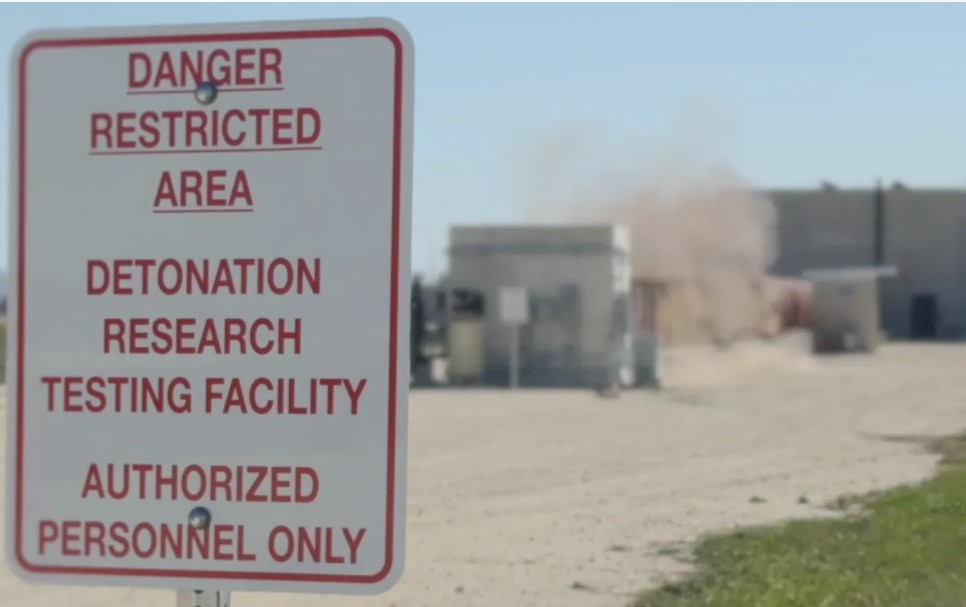
Texas A&M University has unveiled what it describes as the world’s largest controlled-explosion laboratory, a facility designed to study the physics of detonations at unprecedented scale. According to a report from Popular Science, the Detonation Research Test Facility features a nearly 500-foot-long steel tube capable of generating enormous shockwaves under tightly monitored conditions.
Located in southeast central Texas, the tunnel measures roughly six feet in diameter and extends almost the length of two football fields. Its thick steel walls are buried beneath the earth to help contain the force and sound of explosions. Inside the tunnel, researchers have installed sensors and monitoring systems that can record pressure, flame speed, turbulence, and structural effects as explosions intensify.
The project originated from questions raised by the coal mining industry about whether trapped natural gas in mines could transition from a fire into a full detonation. Researchers determined that such explosions were possible, but the investigation soon evolved into a broader scientific effort to better understand explosive combustion across many industries.
Experiments begin with a small spark inside the chamber. As the flame moves through an internal obstacle course of metal beams, turbulence increases the flame’s speed and energy. Eventually, the process generates a powerful shockwave traveling at speeds approaching Mach 5. When the shockwave strengthens enough, it triggers a much larger detonation capable of shaking the entire structure.
Researchers believe the facility could improve industrial safety by helping engineers better understand gas leaks, chemical explosions, and blast-resistant infrastructure. The findings may also contribute to aerospace research involving hypersonic propulsion and advanced spacecraft systems. Scientists studying cosmic explosions such as supernovas could also benefit from data gathered at the site.
The scale of the project reflects growing scientific interest in understanding extreme physical events through full-scale experimentation rather than relying solely on simulations or small laboratory models.
