

Researchers at Jiangnan University, Technical University of Dresden, Laurentian University, and Shanghai International Fashion Education Center have developed knitted textile metasurfaces that let soft robots change shape and color on demand, tells Tech Xplore.
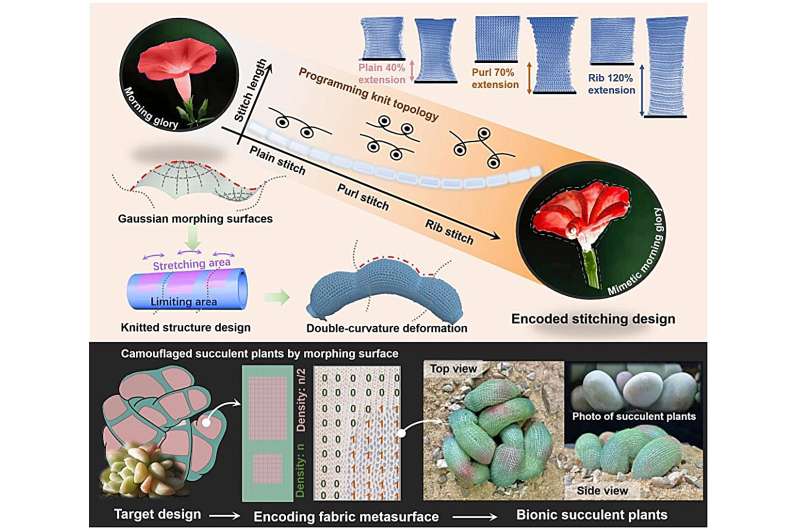
Rather than using special yarns, they program the fabric by tweaking stitch geometry. Changing stitch patterns lets them control fabric behavior using ordinary yarns.
They analyzed how different stitch arrangements affect deformation. Their experiments confirmed that the fabric can morph into complex shapes. The metasurfaces support Gaussian (curvature-driven) deformations, non-Euclidean shape changes, and transformations triggered by inflation. That means a flat fabric can turn into a 3D form or change texture on the fly. That’s not easy with standard materials.
In soft robotics, such programmable deformation gives precise, scalable control over movement and shape. It opens doors for more adaptive, reliable designs.
Potential uses include camouflage skins for robots, wearable devices with adaptive form, thermoregulating urban clothing, and dynamic camouflage for defense or wildlife observation.
These knitted metasurfaces are low cost and scalable, thanks to geometry-based programming instead of exotic materials. That makes them practical for real-world engineering.
Next steps for the team include exploring hierarchical textile structures to improve shape stability and control. They also want to create wearable camouflage clothing that works in real-life settings.
