

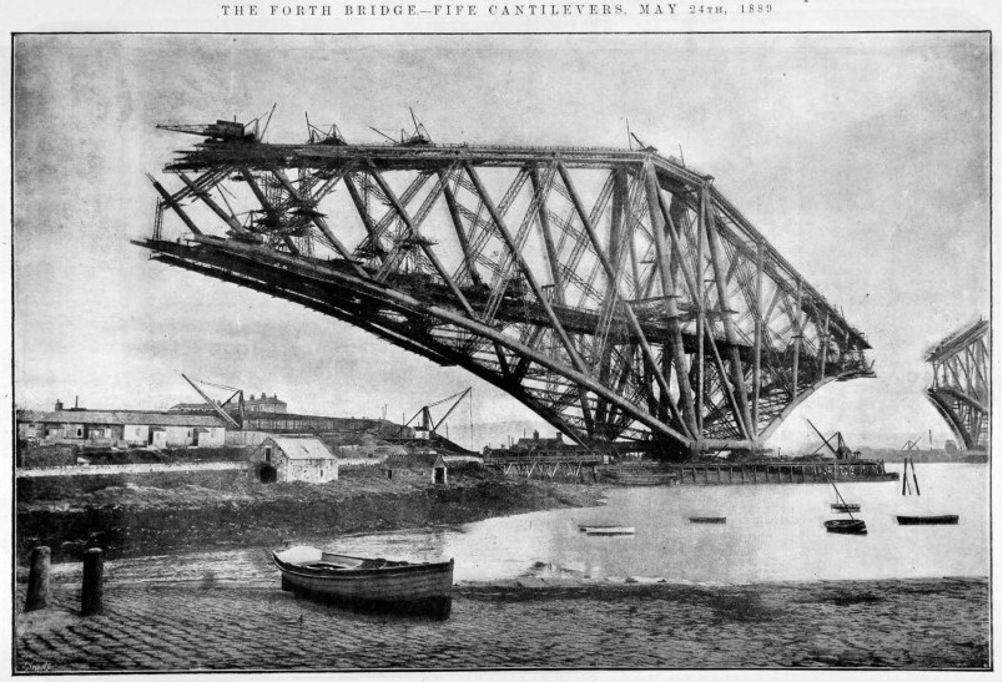
Officially opened on March 4, 1890, by the Prince of Wales, later King Edward VII, the Forth Bridge was hailed as one of the greatest engineering achievements of its age. Spanning the Firth of Forth between South Queensferry and North Queensferry, the structure was designed and built by civil engineers Benjamin Baker and John Fowler, who were also responsible for London’s first underground railway, the Metropolitan line, tells The Engineer.
Measuring just over 2 kilometers in length and rising 46 meters above high tide, the bridge set a global benchmark at the time of completion. Its twin cantilever spans of 521 meters each made it the longest single cantilever span in existence, a record surpassed only decades later by the Pont de Québec in 1917. The scale and boldness of its steel superstructure symbolized Victorian engineering confidence and ambition.
The Engineer chronicled the project extensively. Its February 1890 supplement gathered numerous illustrations and line drawings produced throughout construction, reflecting years of detailed reporting. The publication had followed the bridge’s progress from parliamentary plans through every complex stage of erection, culminating in a large engraving of the completed structure.
Earlier reports from 1885 acknowledged the formidable challenges involved, particularly in preparing and founding the massive piers in the estuary. The tone was restrained, yet it was clear that engineers faced persistent anxiety until the steel superstructure was complete. Technical descriptions detailed the installation of lower bed plates, bolted to iron columns and riveted using specialized hydraulic machines. Ingenious pressure differentials between hydraulic cylinders ensured rivet heads were securely formed, demonstrating mechanical precision at scale.
By 1889, The Engineer compared the achievement favorably with ancient monuments, asserting that even the Colosseum and the Pyramids were modest undertakings beside the complexity of bridging the Forth. The bridge stood not merely as infrastructure but as a statement of industrial mastery.
