

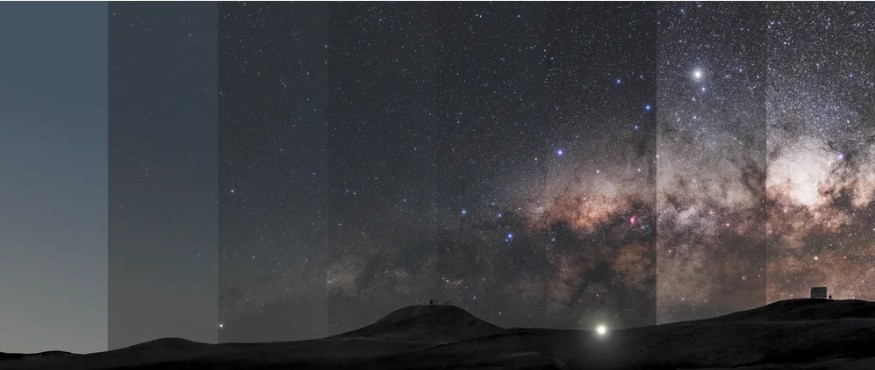
In Chile’s Dark Skies and the Scale of Light Pollution, Paul Bogard reflects on the growing loss of naturally dark night skies, and how much of that degradation is driven by what happens on Earth: artificial lighting, expanding urbanization, and increasing sky glow. The IEEE Spectrum article frames the issue through both scientific scales (like the Bortle scale, which rates sky darkness from 1 to 9) and deeply personal experience, what it feels like to see, or not see, the stars.
Chilean observers in the Elqui Valley and elsewhere used to see spectacular skies, with the Milky Way and distant galaxies vivid to the naked eye. But increases in population, urban light use (including from mining operations and city infrastructure), and more efficient but wrongly managed LED lighting have made that sight increasingly rare.
Some key insights:
- The Bortle scale helps quantify how dark a sky is; almost no places that most people live in are at level 1 or 2 (the darkest); many now are 5 or above.
- LEDs, while energy efficient, often produce blue-white light that scatters more in the atmosphere. Their increased adoption has made light pollution worse despite their efficiency.
- Satellite constellations are contributing too: many satellites make trails in the sky that compete with stars in visibility. The number of visible artificial satellites has swollen, with more predicted in the coming years.
The article also covers the conflict between economic development (mines, infrastructure, urban light) and preserving dark skies. For example, Chile’s mining industry is under pressure to control lighting impacts near observatories and in ecologically sensitive regions. Legal and technological solutions are possible, but often lag behind development.
Bogard ends on a note about loss that is hard to measure, not just the loss of stars, but the loss of wonder, connection, and scale: how the sky reminds us of vast distances, cosmic time, and how small our lives are. He argues that if we don’t act, entire generations may never know what dark skies were like.
