

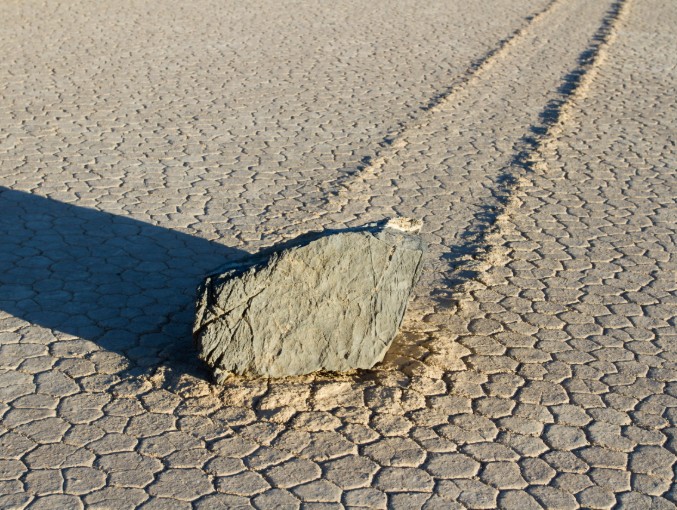
For decades, the sailing stones of Death Valley’s Racetrack Playa puzzled scientists and visitors alike. Large rocks appeared to move across the dry lakebed on their own, leaving long tracks etched into the cracked mud behind them. The phenomenon inspired numerous theories, ranging from magnetic forces and strong winds to more speculative explanations. A Popular Mechanics article revisits this remarkable mystery and the scientific investigation that finally revealed the mechanism behind the rocks’ movement.
Located within California’s Death Valley National Park, the Racetrack Playa is a flat, dry lakebed where rocks weighing hundreds of pounds can seemingly travel significant distances without any visible force acting upon them. The movement occurs so infrequently that researchers struggled for years to witness it directly, making the phenomenon particularly difficult to study.
The breakthrough came when scientists installed GPS trackers and monitoring equipment at the site. Their observations revealed that the rocks move under a rare combination of environmental conditions. During cold winter nights, a shallow layer of water accumulates on the playa and freezes into thin sheets of ice. As temperatures rise the following day, the ice begins to fracture into large floating panels. Even relatively light winds can then push these ice sheets across the wet surface.
As the moving ice panels encounter rocks embedded in the mud, they exert enough force to slowly slide the stones across the lakebed. The movement is gradual and often occurs at speeds too slow for casual observers to notice. Nevertheless, the process can create the long, distinctive trails that have fascinated researchers for generations.
The explanation highlights the importance of patience and long-term observation in scientific research. What once appeared to be an unsolved natural mystery is now understood as the result of an uncommon interplay between water, ice, wind, and geology. The sailing stones remain one of the most striking examples of nature producing extraordinary effects through ordinary physical processes.
