

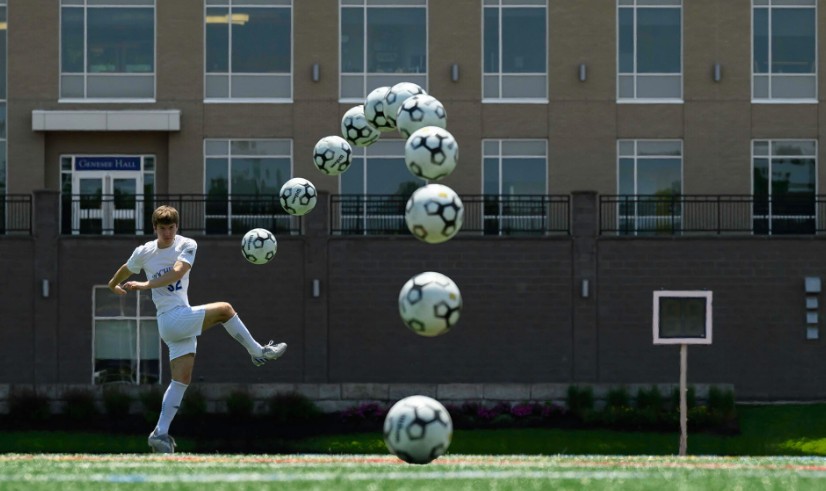
Some of soccer’s most memorable goals appear almost magical, with the ball curling around a defensive wall before dipping into the corner of the net. This article from the University of Rochester explains that these remarkable shots are not magic at all but a demonstration of a well-known principle of physics called the Magnus effect. The same phenomenon influences golf, tennis, baseball, and other sports in which spinning balls change direction during flight.
The Magnus effect occurs because a spinning ball changes the way air flows around it. According to mechanical engineering professor John Lambropoulos, the air moving faster over one side of the ball creates lower pressure, while slower-moving air on the opposite side creates higher pressure. This pressure difference generates a sideways force that causes the ball to curve. The faster the ball spins, the greater the pressure difference and the more dramatic the bend. Depending on the axis of rotation, the ball can curve left or right, rise, or dip toward the ground.
The article uses a memorable free kick scored by University of Rochester midfielder Milos Bisenic as an example of the Magnus effect in action. From an apparently impossible angle, the ball curved around defenders and into the goal, leaving spectators amazed. While the underlying physics is well understood, executing such a shot requires extraordinary skill. Even a slight change in foot placement or the point of contact can dramatically alter the ball’s trajectory, making successful bending free kicks rare even among experienced players.
The article also provides practical guidance for producing a curved shot. Players should approach the ball at an angle, plant the supporting foot correctly, strike slightly below the center using the inside of the foot, and follow through to generate maximum sidespin. Professional players make the technique appear effortless, but Lambropoulos emphasizes that mastering it demands years of practice.
Beyond explaining a spectacular soccer skill, the article highlights the connection between physics and sport. Every perfectly curled free kick demonstrates the principles of fluid dynamics, pressure differences, and rotational motion, showing that science is at work each time a ball bends unexpectedly into the back of the net.
