

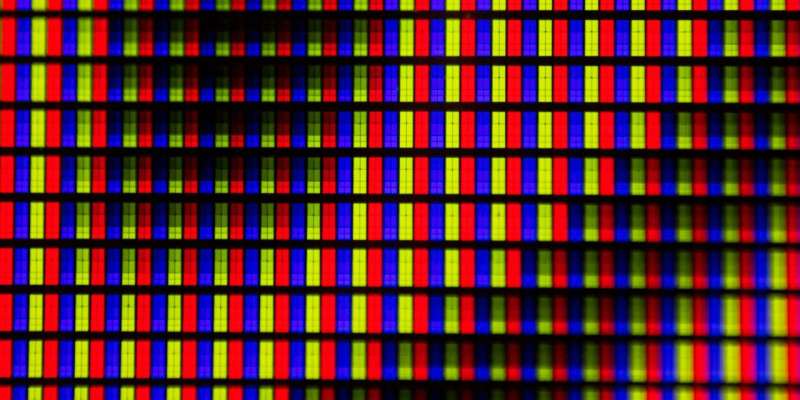
The article on TechXplore traces the evolution of television displays and argues that the long-standing push for higher resolution is approaching a natural ceiling set by human vision. Televisions have progressed from bulky cathode ray tube (CRT) systems to ultra-thin flat panels, with each generation promising sharper images and richer colors. Yet this steady improvement raises a critical question: can displays keep getting better in ways people can actually perceive?
The article explains that early CRT televisions created images by sweeping electron beams across phosphor-coated screens, forming pictures from glowing points. Modern displays, such as LCD and OLED, have replaced this mechanism with far thinner and more efficient technologies, enabling higher resolutions and improved image quality. However, these advances are no longer unconstrained.
A central argument is that human vision imposes hard limits. The eye can only resolve a finite level of detail, often measured in pixels per degree of visual field. Research cited in the article suggests that the average person can distinguish roughly 94 pixels per degree. In practical terms, this means that under typical viewing conditions, the difference between 4K and 8K resolution becomes negligible unless the viewer is unusually close to the screen.
Beyond resolution, other physical constraints also come into play. Screens cannot increase brightness indefinitely without becoming uncomfortable or even harmful to view. Similarly, reproducing the full range of colors visible to the human eye remains a complex technical challenge. These factors reinforce the idea that simply adding more pixels is no longer the most meaningful path forward.
The article concludes that future improvements in television technology are likely to shift away from raw pixel counts. Instead, advances will focus on contrast, color accuracy, motion handling, and immersive viewing experiences. As displays approach the limits of what the human eye can perceive, the industry’s focus is moving from quantity of pixels to quality of perception.
