

Humanoid robots can now walk, run, and perform impressive full-body movements, yet they still struggle with a deceptively simple task: manipulating everyday objects. The article from The Strange Review argues that the true bottleneck in robotics is not intelligence or locomotion, but the robotic hand. This small subsystem has emerged as the limiting factor preventing humanoids from achieving practical, real-world utility.
The difficulty stems from three compounding challenges: cost, complexity, and failure density. Despite representing only a small portion of a robot’s physical structure, hands account for a disproportionately large share of total system cost. For example, estimates suggest they can make up roughly 17% of the bill of materials in advanced humanoids.
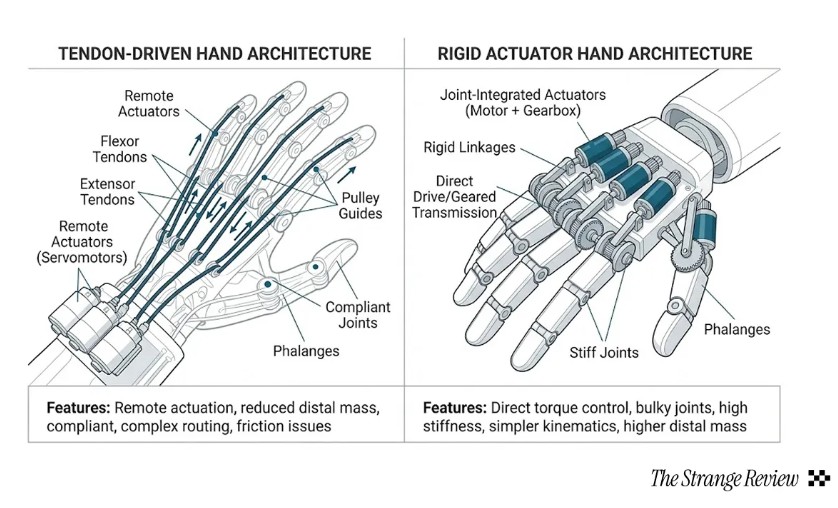
Mechanically, robotic hands are far more complex than other parts of the body. With over 20 degrees of freedom in some designs, they require significantly higher control precision than limbs like legs. Many systems rely on tendon-driven actuation to mimic human anatomy, which improves flexibility but introduces additional failure points and engineering challenges.
Performance data highlights the gap. Robots can reliably grasp simple objects such as balls or apples, but success rates drop sharply when handling tools or irregular items such as scissors or screwdrivers. This reflects the inherent difficulty of fine manipulation, where slight variations in shape, texture, or orientation demand continuous adjustment.
The problem is further divided into actuation and sensing. Actuation deals with physical control and compliance during contact, while sensing involves understanding what the hand is touching. Tactile sensing remains underdeveloped, with fewer than half of robotic hands integrating it effectively, limiting the ability to detect slip, force, or texture in real time.
As a result, even advanced humanoid robots are often restricted to basic tasks such as navigation and simple pick-and-place operations. The article concludes that solving the hand problem will define the next phase of robotics, determining which companies lead the transition from demonstration to deployment.
