

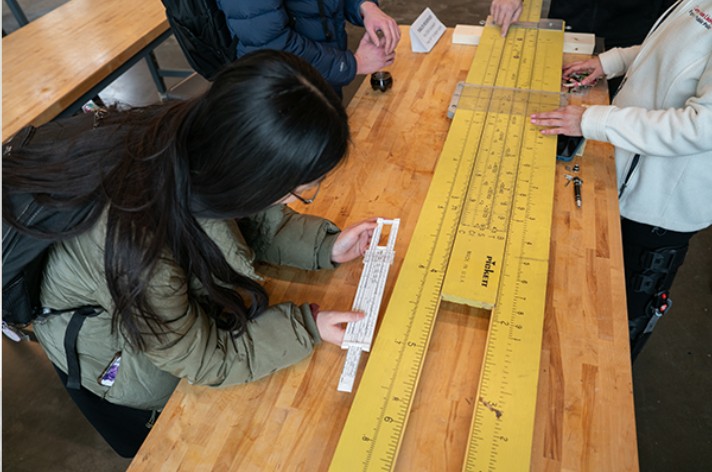
At Carnegie Mellon University’s Engineering Week 2025, a seven-foot-long wooden slide rule was introduced to grab attention and bring a vital piece of engineering history into focus. Hung above Professor Deanna Matthews’ office couch, this oversized analog tool recalls an era when slide rules were the go-to for calculations that helped send humans to the moon, says College of Engineering, Carnegie Mellon University.
Before pocket calculators arrived, slide rules were everywhere, from classrooms to careers. Engineers needed them for quick calculations and building a gut feel for powers of 10. Some faculty worried that calculators would weaken students’ estimation skills, but experience showed that isn’t the case.
The slide rule isn’t just a relic; it represents how estimation and numerical intuition remain foundational. In an Intro to Engineering and Public Policy class, Matthews uses that concept to show students how thinking in powers of 10 simplifies problem-solving, and when precision is needed, calculators step in.
The analog logic behind slide rules echoes the same principles that underpin algorithms—the DNA of modern AI. Though slide rules themselves are obsolete, their role in nudging engineers toward computational thinking helped pave the path to digital calculators and, eventually, modern computing.
During the university’s Engineering Week, Matthews and Associate Dean Conrad Zapanta displayed the giant slide rule in ANSYS Hall. They paired it with smaller, functional slide rules and invited students to try them out. Some students had never seen one. Zapanta made a neat comparison: slide rules essentially bring logarithm tables to life under your fingers.
Students tried a few calculations; some were glad for calculators, others seemed captivated by how it worked. Zapanta pointed out how calculators, too, are on their way out, mostly replaced by computers and phones.
These artifacts, and their stories, matter. They trace how tools evolve and remind students that understanding core ideas gives context to the tech we take for granted today.
