

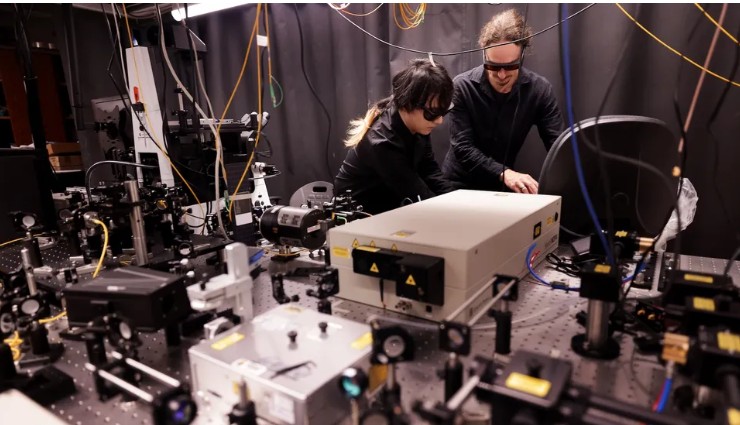
A team of researchers led by the University of Michigan has developed a new kind of switch, called an optoexcitonic switch, which could radically reduce or even eliminate the waste heat produced by electronic devices. The breakthrough promises electronics, from phones and laptops to data centers, to run cooler, more efficiently, tells Live Science.
In conventional electronics, switching (turning circuits on/off, routing signals, etc.) relies on moving electrically charged particles (electrons). That movement causes resistance and generates heat, which we’d call waste heat. The optoexcitonic switch uses a different carrier: the exciton, a quasiparticle formed when an electron is knocked free but remains paired (via electrical attraction) with the hole it left behind. Since excitons are neutral as a whole, moving them does not produce the same kind of resistive heating.
The researchers built a prototype of this switch and found it already rivals, even surpasses, the performance of leading photonic switches. That means signal speed, switching properties, etc., are competitive with state-of-the-art devices.
Getting excitons to move reliably was among the engineering challenges. Since they have no charge, typical electrical fields won’t push them. The team used light (photons) to create and guide them along narrow ridges (“one-dimensional planes”). They also discovered there’s a “magical thickness” of material needed so that the interactions that let light push excitons work correctly, too thin or too thick, and the behavior breaks down.
There are still hurdles. Scaling up materials, integrating the switches into circuits, manufacturability, and stability are not yet solved. But the researchers believe these challenges may be surmountable over the next few decades.
If successful, this could change fundamentals: phones that stay cooler, laptops that don’t need big fans, data centers that consume much less energy, and more efficient classical and quantum computing. The optoexcitonic switch could help address one of electronics’ biggest limits: waste heat.
