

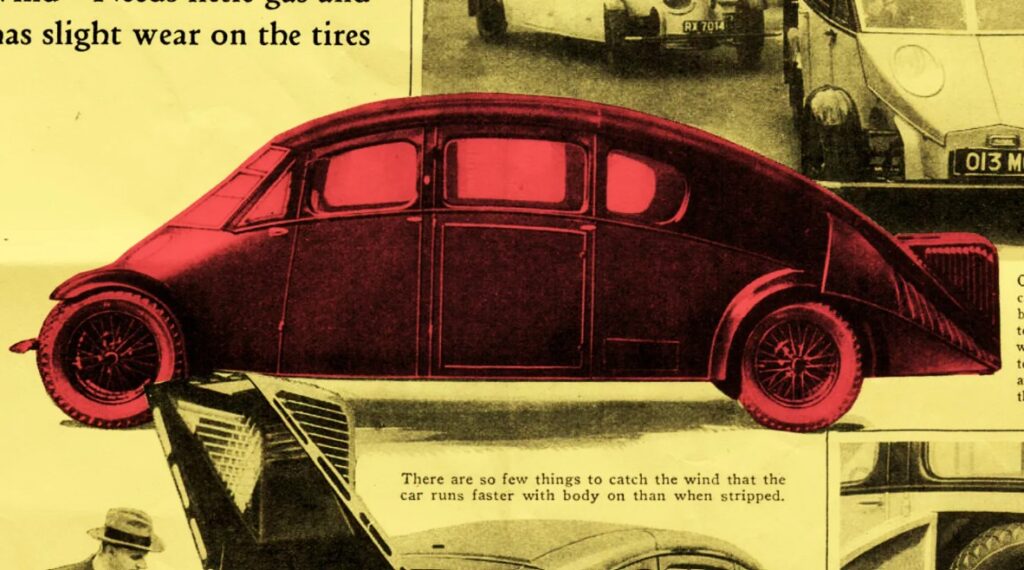
The teardrop-shaped car represents one of the clearest examples of engineering insight arriving long before market readiness. As detailed in Popular Science, early 20th-century engineers discovered that most automobiles were fundamentally inefficient because they ignored aerodynamics. Wind tunnel experiments led by Chrysler researcher Carl Breer revealed a striking result: cars of the era were often more aerodynamic when driven backward than forward.
At roughly the same time, thinkers like Buckminster Fuller and airship engineer Dennis Burney independently arrived at the same conclusion. The most efficient shape for moving through air was not boxy or upright, but a smooth, rounded front tapering into a long tail, resembling a teardrop. This geometry allows air to flow cleanly around the body, minimizing turbulence and drag.
The physics were compelling. At highway speeds, as much as 85% of a car’s energy can be spent overcoming air resistance. A well-formed teardrop shape dramatically reduces this burden, with theoretical drag coefficients far lower than conventional vehicles.
Despite these advantages, teardrop cars never became mainstream. Their unconventional appearance, combined with practical challenges such as interior space and manufacturing constraints, made them difficult to sell. Cheap fuel throughout much of the 20th century also reduced the urgency for efficiency, allowing less aerodynamic designs to dominate.
Today, the logic behind the teardrop is returning, especially in electric vehicles where efficiency directly affects driving range. Models such as the Lucid Air and Mercedes-Benz EQS reflect a renewed focus on airflow optimization. What was once dismissed as impractical is now increasingly relevant.
The story highlights a recurring pattern in engineering: solutions can be technically correct yet commercially premature. The teardrop car was never wrong. It simply arrived before the world had a reason to care.
