

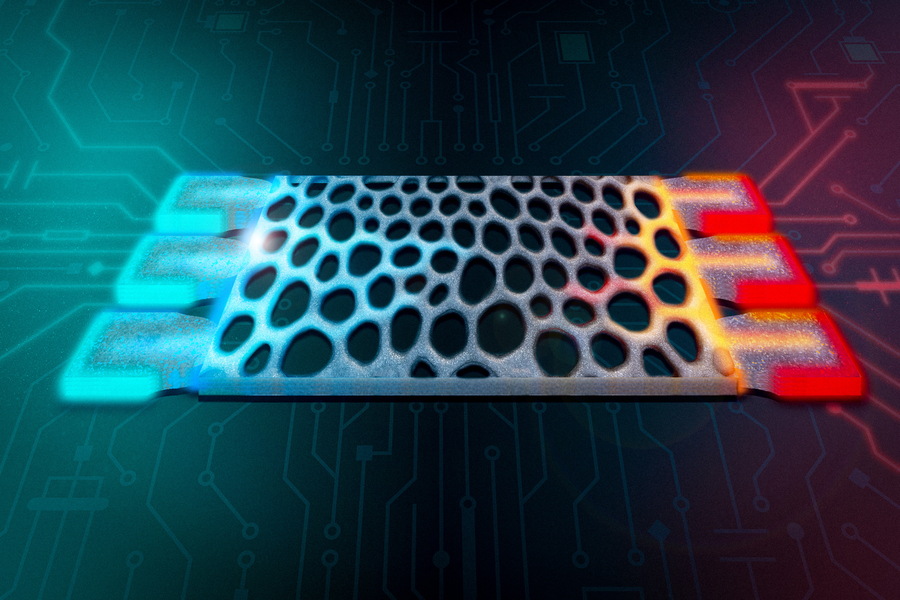
MIT engineers have created microscopic silicon structures that perform calculations using heat instead of electrical current. The idea is to encode data as a set of temperatures and let the way heat flows through a designed material carry out the computation. These structures could reduce energy use in thermal sensing and signal processing by turning waste heat into a useful signal, rather than discarding it, tells MIT News.
The team demonstrated matrix-vector multiplication, a core calculation in machine learning, using these heat-driven devices with over 99% accuracy in simulations. Matrix multiplication underpins tasks such as prediction and classification in models such as large language models, but scaling this method to handle modern deep-learning workloads remains a challenge.
At the heart of the work is an inverse-design software system. Instead of starting with a fixed geometry and testing performance, researchers define the function they want, and the software iteratively designs the best structure. It produces silicon blocks, each roughly the size of a dust particle and peppered with tiny pores. When heat flows through these geometries, the distribution performs the desired mathematical function.
Heat naturally flows from hot to cold, so the structures can encode only positive coefficients. To handle negative values, the researchers split a target calculation into positive and negative components, each realized in separate structures, and then subtract outputs. They further adjust the thickness to broaden the range of matrices the system can represent.
Practical use is still limited. Larger computations require vast arrays of these structures, and accuracy drops for complex, spread-out designs. Bandwidth also needs improvement before heat computing could rival electronic systems in deep learning.
Still, these thermal devices have immediate promise in temperature sensing and thermal management within chips. They could detect localized heat without extra digital components, offering direct insight into gradients that can damage circuits. Future work will focus on sequential and programmable heat-computing structures that link operations in series, moving closer to practical analog computation with heat.
