

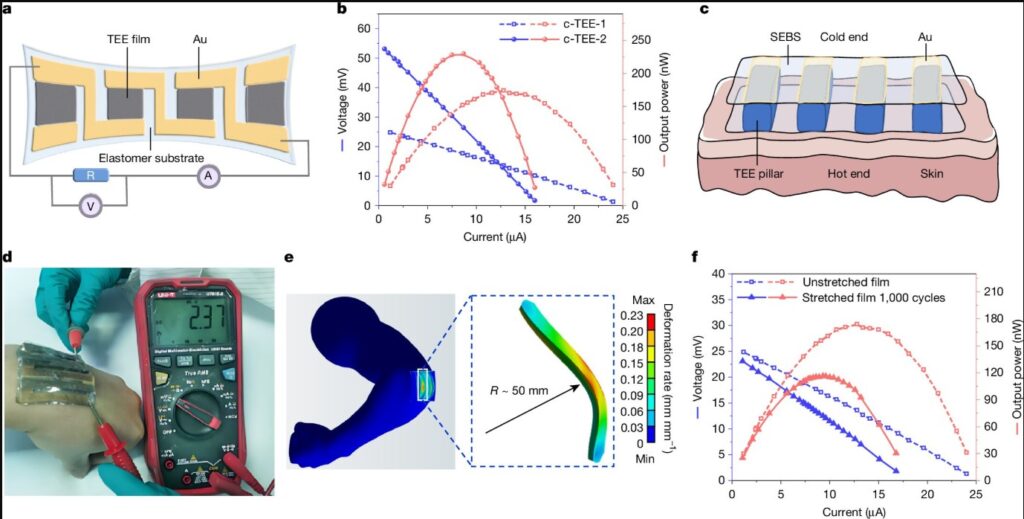
Researchers at Peking University have engineered a rubber-like material that converts body heat into electricity, utilizing the natural temperature difference between skin and ambient air to generate power. Dubbed a thermoelectric elastomer, it blends semiconducting polymers with elastic rubber to maintain conductivity even when stretched, tells Tech Xplore.
That stretchability is impressive: the material recovers its shape after being stretched to 150% and survives strains beyond 850%; imagine a rubber band that snaps back almost no matter how far you pull. A tiny amount of a specialized dopant, N-DMBI, boosts its electrical performance, making the flexible material efficient under strain.
How does it work? Thermoelectricity relies on temperature differences to move electrons. With skin at about 37°C and the air cooler, the material taps that gradient to produce electricity.
This isn’t lab-only science. It opens real-world applications:
- Wearable tech: Smartwatches, fitness trackers, and health monitors could run continuously without bulky batteries or frequent charging.
- Medical devices: Patient-worn monitors could be powered by body heat alone, eliminating battery changes.
- Clothing interfaces: Imagine garments that power your phone in your pocket, or manage your body temperature by routing heat where it’s needed.
- Remote gear: In areas without electricity, low-power sensors or communication devices could tap human heat, and maybe even campfire warmth, to operate.
Thermoelectric rubber turns your body into a power source—lightweight, flexible, low-maintenance. It solves durability and comfort challenges while delivering a new kind of self-powered wearable. Just a rubber band and your own heat, doing the rest.
