

Automated factories are yesterday’s news. The news today is all about AI and the factory of the future is one staffed with AI agents.

If the idea of AI agents makes you think of Agent Smith in The Matrix series, you are not far off. Agent Smith, part of the AI that prevailed over humans, was able to assess and evaluate, decide on action, and execute — all on its own. Agent Smith, along with other agents, identified problems that could disrupt the system (like Neo, the human hero of the movie) and attempted to eliminate them. The difference between fiction and fact: Agent Smith helped wipe out humans, whereas in real life, AI agents will help them.
The AI industry does not admit that their agents are derived from The Matrix, claiming they took the term from texts on psychology and philosophy that refer to agency, the capacity to act intentionally. Aristotle discussed the concept of individuals being able to act independently. Centuries later, Immanuel Kant referred to “autonomous agency,” by which individuals can act according to their reasoning.
Back to reality. And into the modern factory. Here is a factory that could be a result of a national reshoring initiative. It should, for reasons explained in The Agentic Shift: Building Intelligence into the Fabric of Industry, an eBook by First Resonance, take advantage of the latest technology. It is not a factory that has been retrofitted; rather, it is the result of plugging in new machines and adding software to manage traditional workflows. That would risk recreating the problems that made manufacturers abandon the factory in the first place. No, it must be a factory created afresh, from a clean screen, from the ground up, with new tactics and workflows and, most important to this story, the latest AI breakthrough: agents.
From Automation to Agency: Why AI Agents Are Fundamentally Different
Traditional automation has been the backbone of industrial progress for decades. It excels at performing repetitive tasks with high precision; however, its limitations are becoming increasingly apparent in today’s volatile and complex manufacturing environment. Automation systems execute fixed, hard-coded sequences—they cannot adapt to unexpected scenarios without manual reprogramming. In other words, automation follows instructions but does not reason with them.
By contrast, agentic AI represents a step-change. AI agents combine machine learning, real-time sensing, and autonomous control to create a closed-loop process of observation, decision and action. Rather than simply carrying out predefined commands, agentic systems sense changes, learn from new data, reprioritize goals and respond dynamically. This makes them more like intelligent, trained human co-workers than programmable controls.
For example, a traditional pick-and-place robot can perform the same sequence regardless of upstream, instream and downstream disruption. A pick-and-place cell may be able to stop action after it senses it has run out of a necessary component, but after that, it can only wait for human intervention. A pick-and-place cell with agentic agents, on the other hand, could anticipate that the hopper is about to run out of components and alert another AI agent to refill it. In theory, AI agents could go much further upstream, up the supply chain to alert purchasing of potential overseas supply issues (think: semiconductor shortages in a time of war or invasion). Agents could monitor instream processes, reading data from cutting machines, production or packaging machines, to assess the need for preventative maintenance and order replacement parts. They could monitor excessive tool wear by measuring increasingly out-of-tolerance parts. Agents could also help downstream of operations, warning of overproduction and that the warehouse shelves are full.
It is this type of adaptive capability that will enable factories to shift from basic efficiency to resilient, reflexive operations.
Agents Everywhere All at Once
A factory foreman, no matter how experienced and intelligent, cannot be like the protagonist in Everything Everywhere All at Once, existing in parallel timelines to see every possible outcome. But AI agents can. Just as in The Matrix Revolutions, where thousands of Agent Smiths replicate across systems, agentic AI deploys intelligent counterparts into every machine, process, and workflow—each able to learn, decide and act on their own, simultaneously.
This distributed intelligence marks a radical departure from the legacy model, which relies on a single central controller or a patchwork of specialized automation scripts. What we have is an agentic mesh, a decentralized ecosystem of specialized AI agents that coordinate with one another in real-time.
Traditional automation relies on periodic human intervention to change its rules. Without human intervention, automation is static and relies on static rules. Agentic AI, on the other hand, is situationally aware and adapts the rules to accommodate the situation. Being in multiple locations, able to act individually and independently, it can appear to be the factory foreman’s assistant, but in many places.
The factory foreman is still the human in the loop. However, their tribal knowledge is spread far and wide. Imagine a big manufacturer could take its most experienced and effective factory foremen, distill all they have learned, add to that their problem-solving superpowers, and multiply it by a thousand. Here are assistants who never sleep, call in sick, ask for a raise, or go on strike. They are assistants who can think a thousand times faster, listen constantly, and watch unblinkingly. They can adapt to changes. They can optimize.
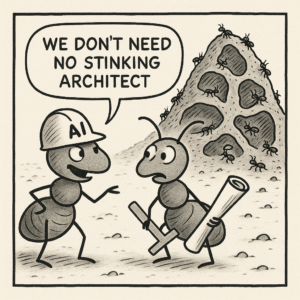
Agents employ the concept of hive learning, where intelligence is distributed across multiple locations rather than being centralized in one location. Think of an architect designing a house in their office and construction workers completing it. Compare that top-down centralized approach to ants making an anthill. The ants build anthills without a chief architect and are, in many ways, better off. They can communicate with each other and respond to conditions as they arise. What is not encoded in their little ant-brains, they manage to figure out. They are driven by a purpose, adapt to changes along the way, and keep the anthill running.
Real-World Examples of Agentic AI in Action
Agentic AI is more than a theoretical upgrade to automation—it is already driving measurable improvements across industries. Whether applied to a simple assembly cell or an entire aerospace production line, these systems share a common DNA: continuous sensing, adaptive decision-making, and autonomous execution.
Here are a few ways AI agents can help:
- Scheduling. Instead of halting production, an agentic system automatically reschedules the next best job in the queue, adjusts robot speeds, and notifies supply teams to replenish parts, all without requiring manual reprogramming.
- Visual Inspection. Traditional inspection systems detect defects and alert operators to take action. An agentic quality agent, on the other hand, will take matters into its own hands, so to speak. It can adjust, recalibrate equipment, and re-route suspect parts for rework and further validation—all in real-time.
- Energy Optimization. In energy-intensive operations like battery manufacturing, agentic AI can help by forecasting power requirements based on production forecasts to make maximum consumption of power during non-peak grid pricing times
Agents Are Already at It
Cutting-edge manufacturers already deploy agentic systems:
- Tesla uses synthetic vision AI to monitor every stage of production in its Gigafactories, as manufacturing facilities are known, according to Aicadium. “AI-powered quality control systems [AI agents, in effect] can identify defects in real-time, enabling immediate corrections, reducing waste and enhancing overall efficiency”
- Battery gigafactories are already leveraging agentic energy-pricing agents to reschedule heating processes during off-peak hours, shaving 8–12% off per-cell energy costs.
- Joby Aviation, a leader in eVTOL (electric vertical takeoff and landing) technology, achieved a 98% reduction in rework during composite manufacturing by utilizing autonomous quality agents to monitor and adjust processes, according to First Resonance.
- Relativity Space, a rocket company, has improved throughput by 30% in full-stack additive manufacturing workflows by leveraging agentic AI to dynamically allocate jobs and coordinate machine settings across its print fleet, according to First Resonance.
- K2 Space, a satellite manufacturer, has implemented autonomous quality assurance agents capable of zero-defect part validation, which reduces downstream inspection bottlenecks, according to First Resonance.
How AI Agents Work: For Millions of Events
Agentic AI does not need a single major revelation to be worth the price of admission. Instead, it can be valuable in accumulating minor, continuous improvements that compound over time. In production environments such as machining or assembly, these systems can observe thousands of micro-variables—such as tool wear, cycle times, operator adjustments, and material inconsistencies—and learn from each incident.
For example, a scheduling agent might detect that a particular CNC machine consistently slows down during the third shift. The daytime human supervisor might eventually notice this pattern, or they might not. But an agentic system analyzing around the clock, every 30 seconds, would have a report ready the next morning and may even have a recommendation.
The eBook notes that analyzing every thirty seconds may seem excessive, but over an 8-hour shift, that provides 960 opportunities to catch problems and 960 opportunities to make adjustments. An AI agent could issue a fix in 30 seconds for a problem that would otherwise have to wait for a shift change and human intervention.
How AI Agents Work: For Million-Dollar Events
“The most powerful factory doesn’t just catch errors. It prevents them.”
While many agentic gains accrue incrementally, the same architecture is equally powerful in preventing single catastrophic events. In highly regulated industries, such as nuclear energy, aerospace, and pharmaceuticals, the stakes are too high to rely on reactive intervention after a crisis has begun.
Agentic systems work proactively to detect and defuse looming risks before they escalate into shutdowns or recalls. The eBook highlights predictive-maintenance agents that constantly scan live telemetry and historical patterns to flag early-warning signals—a subtle vibration spike, an unexpected temperature fluctuation, a supply chain delay likely to cascade into line stoppage.
In power generation, this automated and dependable vigilance means that a power plant doesn’t wait for a turbine fault to trip an emergency shutdown. Instead, the AI agent continuously monitors each subsystem, dynamically updating risk profiles and recommending precise preemptive interventions. For example, suppose a forming line in a battery plant deviates from specification. In that case, the system doesn’t just raise an alert—it automatically reschedules other production and orders replacement parts before throughput is affected.
Summary and Conclusion
AI agents have the power not only to optimize day-to-day operations but also to shield entire enterprises from the catastrophic ripple effects of a single unmitigated failure.
AI agents provide incremental intelligence over millions of increments. They are the flexible alternative to the brittle automation of yesterday, which is the automation of fixed systems that operate within static parameters. Instead, AI agents continually expand their understanding of normal and abnormal, steadily tightening efficiency and consistency over time. Fast-acting and far-reaching, they are able to work everywhere at once, requiring no human intervention. Only with a robust factory automation that includes AI agents can U.S. factories compete with factories in countries with cheap labor.
