

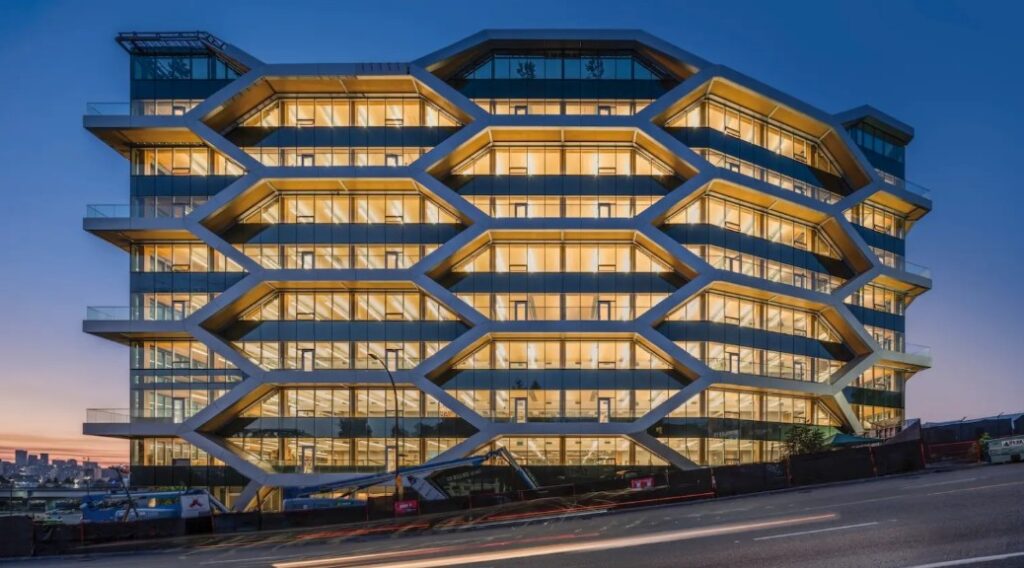
Modern skyscrapers owe their existence to a simple principle found in nature: flexibility. Trees bend in strong winds rather than snap, and early high-rise buildings adopted similar behavior using steel. Now, architects are returning to wood, not out of nostalgia, but because new engineered timber materials can replicate and even enhance these structural qualities, according to this Grist article.
The article centers on “mass timber,” including cross-laminated and glue-laminated wood, which is created by bonding layers of smaller wooden pieces into strong, lightweight structural elements. These materials are flexible yet durable, allowing buildings to sway safely under wind or seismic forces. Advances in engineering have pushed timber construction to new heights, with buildings reaching 15–25 stories and projects such as Milwaukee’s Ascent tower demonstrating its viability.
Environmental considerations are driving much of this shift. Steel production carries a heavy carbon cost, while timber offers a different equation. As trees grow, they absorb carbon dioxide, which remains stored in the building once the wood is used. This transforms buildings into long-term carbon reservoirs rather than sources of emissions.
The material also aligns with evolving forest management practices. Engineered timber can be made from smaller, more abundant trees, reducing reliance on old-growth forests. Selective harvesting can help thin overcrowded forests, lowering wildfire risk and supporting ecological balance.
Safety and performance concerns, particularly around earthquakes, are addressed through hybrid systems. Timber buildings often incorporate technologies such as dampers and “rocking walls,” which absorb and dissipate energy during seismic events. Testing has shown that such structures can endure repeated earthquake simulations without significant damage.
The article ultimately frames timber construction as both a technological and environmental evolution. Rather than replacing steel entirely, it represents a complementary approach that merges natural material behavior with modern engineering. As cities confront climate pressures and demand more sustainable infrastructure, engineered wood is emerging as a credible path forward for building taller, lighter, and cleaner structures.
