

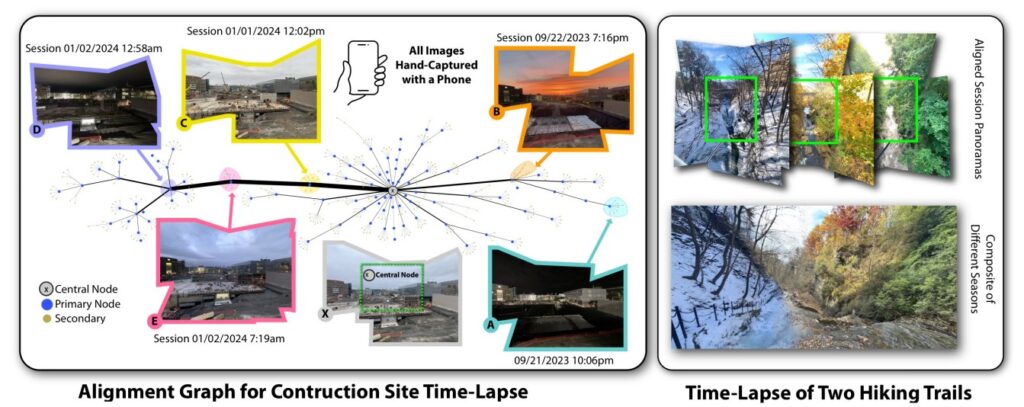
Time-lapse video has always been a powerful tool for visualizing slow processes, but traditional reconstruction methods often struggle with flicker, abrupt transitions, and loss of temporal coherence. The researchers at Cornell University introduce time splatting, a novel approach that rethinks how frames are combined over time. Instead of treating each image as a discrete snapshot, the method encodes frames as spatiotemporal splats that smoothly blend across moments, producing fluid, artifact-free reconstructions. This shift opens up new possibilities for computer vision, robotics, and monitoring applications where clarity across long time spans is critical.
At its heart, time splatting treats each time-lapse frame like a small “time Gaussian”—a point in a spatiotemporal field. Each “splat” encodes not just spatial position but a time stamp and temporal spread (variance). When you render the scene at any chosen moment, these Gaussians collectively contribute, weighted by how close their time tags are to the target timestamp. That means the output blends frames smoothly over time, reducing jerkiness and creating fluid transitions—all without manually tuning frame-by-frame interpolation.
Under the hood, the system builds a compact, dense representation by initializing temporal splats at each pixel or a grid of keypoints. During rendering, it aggregates contributions from neighboring time splats based on a temporal kernel, typically Gaussian-weighted, which limits computations to a manageable local neighborhood in time. This results in high-quality, alias-free time-lapse reconstruction with natural motion blur when needed, and crisp sharpness otherwise.
Time splatting also supports efficient real-time playback at arbitrary speeds. Since the method relies only on pre-computed splat attributes plus a fast kernel evaluation, it’s lightweight and responsive—handy for robotics or UI tools that visualize compressed-long-duration data.
Although full technical details and performance comparisons aren’t directly accessible, time splatting seems aimed at solving the typical time-lapse artifacts, such as jerkiness, flicker, and misaligned frames, through a well-designed, time-aware splat rendering mechanism that brings visual continuity. This can be particularly useful in fields where time-series capture is essential—environmental robotics, surveillance, process monitoring—especially when clarity and smoothness across time matter.
