

In this article, IEEE Spectrum explores a radical shift in thinking about interstellar travel. Instead of lumbering starships powered by fusion or fission, the new model relies on ultra-light probes, mere grams in mass, propelled by high-power lasers to a fraction of light speed.
The proposed probes use discs made of aerographene or comparable materials just micrometers thick. One side carries sensors and communications hardware, the other is reflective to catch the laser push. Their rims hold the power electronics and form a ring that supports laser-based communication back to Earth. A 100-gigawatt laser (built as a phased array of smaller lasers) would accelerate these tiny spacecrafts to about 0.2 c, or 20% of light speed.
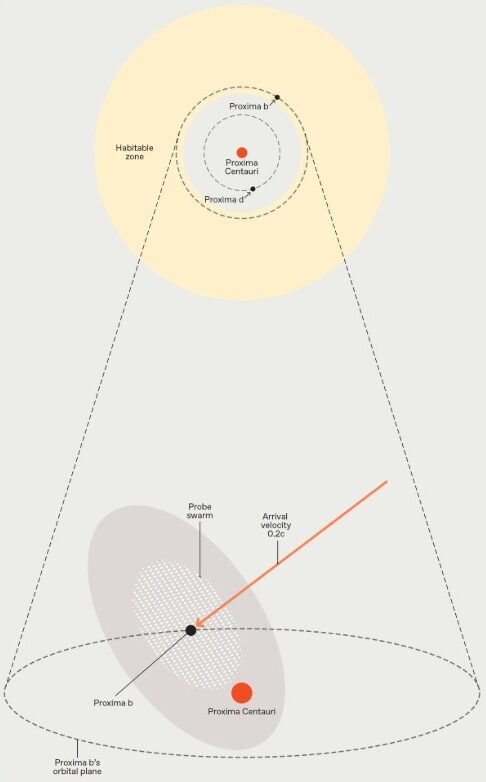
To make the mission efficient, multiple probes are launched sequentially at different velocities. By the time they reach a target system, for example, Proxima Centauri, 4.2 light-years away, they merge into a swarm. Once in the neighborhood, they’ll turn their synchronized transmitters into a giant signal directed at Earth, returning data at about 1 kilobit per second.
This approach contrasts sharply with older designs, which assumed massive spacecraft and much longer travel times. The new concept reduces travel to decades rather than centuries. For a flyby mission to Proxima b (the closest exoplanet in the habitable zone), a 0.2 c probe swarm could deliver images in perhaps 25 years post-launch.
The idea originates from a research team led by Thomas Marshall Eubanks, evaluated under NASA’s Innovative Advanced Concepts program. Though it didn’t advance to phase two in its 2024 evaluation, the team plans to reapply in 2026. If successful, the technique could yield gigapixel-level imaging of exoplanets, enough detail to spot surface features like airports or coral reefs.
The article argues that miniaturization and laser propulsion may unlock interstellar exploration sooner than we thought. Instead of dreaming of vast starships, we may send fleets of micro-scouts to chart the cosmos.
