

This IEEE Spectrum article profiles Toshiba and its LTO-based “SCiB” batteries as a growing alternative to traditional lithium-ion and lead-acid packs, especially in low-power vehicles, industrial equipment, and energy-storage systems.
Unlike conventional lithium-ion cells that use graphite anodes, SCiB batteries employ a lithium-titanate (LTO) anode. This change trades energy density for several advantages: far faster charging, much longer cycle life, strong performance across a wide temperature range (even down to –30°C), and greater safety. For instance, TFT’s LTO cells deliver over 20,000 charge cycles, rapid recharge rates, and robust operation in harsh climates, properties that make them attractive where reliability and longevity matter more than maximum energy storage.
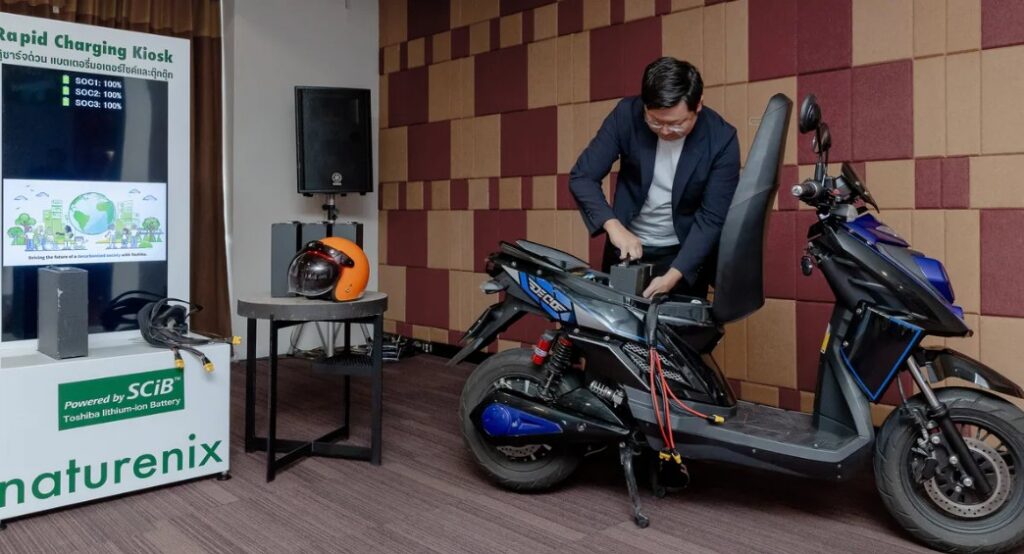
Toshiba offers SCiB not just as individual cells but as modular packs and configurable units, enabling deployment across scales from small scooters to industrial energy systems. In a recent demonstration in Bangkok, the company revealed a 24-volt SCiB battery pack designed to replace lead-acid batteries in electric motorcycle-taxi fleets. The trial included a battery-swap service concept: riders can exchange depleted packs for charged ones, enabling near-continuous operation. Early data suggest such packs can last over 10 years even in hot climates, with potential longevity reaching 18 years under proper maintenance.
Beyond mobility, SCiB batteries are being eyed for energy-storage systems, renewable-energy buffering, maritime vessels, and industrial power backups, i.e., applications where fast charging, long life, and safety matter more than raw energy density.
For engineers and designers working on electric mobility, grid storage, or industrial energy systems, Toshiba’s LTO-SCiB approach provides an interesting model: a trade-off favoring durability, reliability, and rapid recharge over maximum energy per kilogram. That trade-off could align well with use cases where swapping or frequent charging is practical, or where safety and long cycle life outweigh outright battery range.
