

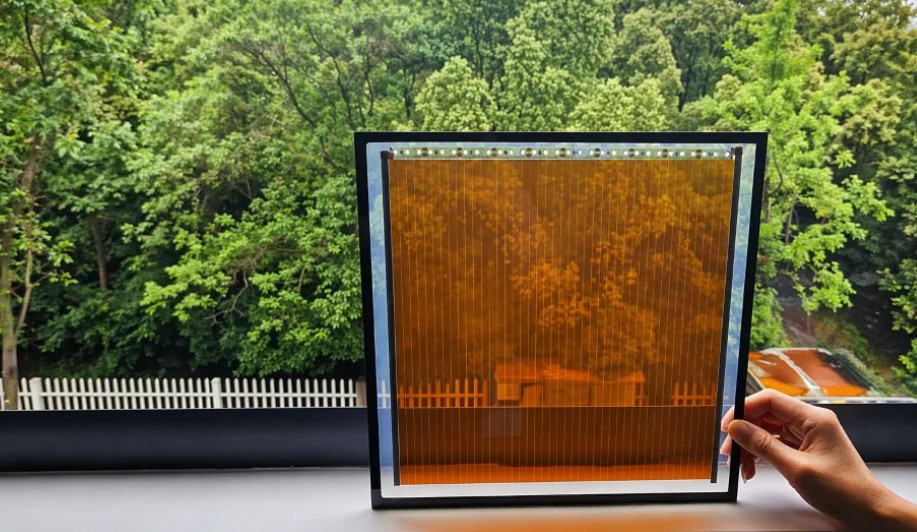
Researchers at University College London have developed semi-transparent solar windows that generate electricity from both sunlight and indoor light while still allowing natural light to pass through. The technology could enable buildings to produce electricity throughout the day, including during cloudy weather and at night under artificial lighting, making windows an active part of a building’s energy system rather than simply a structural feature, tells The Engineer (free registration required).
Unlike conventional glass, which transmits 80–90% of sunlight, the new solar windows allow about 30% of light to pass through while delivering record levels of electricity generation from indoor lighting. According to the researchers, this approach could unlock the vast untapped energy potential of the glass surfaces found in modern buildings.
The technology is based on perovskite, a material that has attracted significant interest for its high efficiency and adaptability. Using computer modeling, the team optimized the arrangement and thickness of the solar cell layers, creating an 185-nanometer-thick light-absorbing layer that balances transparency with energy production. They also introduced a specialized molecule that reduces defects in the perovskite, improving both efficiency and long-term stability.
To further enhance performance, the researchers redesigned the transparent electrode. Instead of a conventional gold electrode that blocks light, they placed a thin gold layer between two transparent molybdenum oxide layers. This structure reduces light reflection, allowing more light to pass through while maintaining electrical performance.
The researchers successfully produced a 30 centimeter by 30 centimeter panel that converted 22% of bright indoor light and 14% of sunlight into electricity. The device also retained 80% of its efficiency after 300 hours of accelerated durability testing.
Beyond electricity generation, the windows also function like tinted glass, reducing solar heat gain and lowering air conditioning demands. The researchers envision future flexible versions that could be applied directly to curved windows, vehicle glass, sunroofs, backpacks, and other transparent surfaces, making clean energy generation easier to integrate into everyday environments.
