

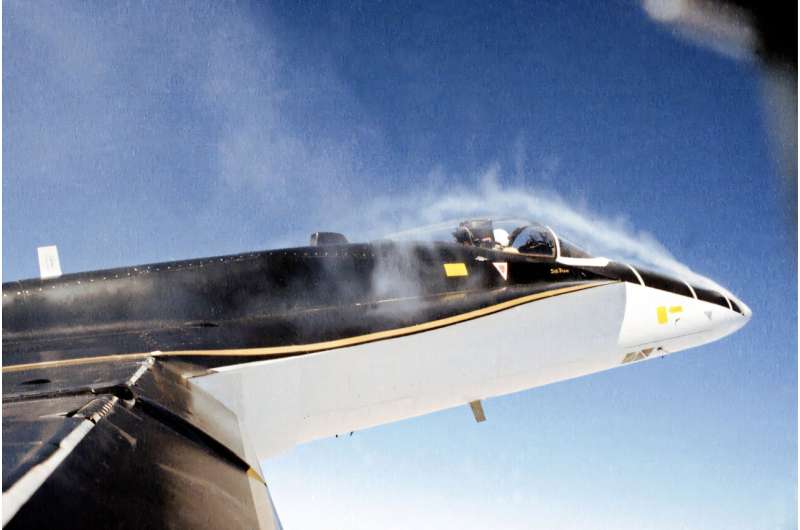
Researchers at the FAMU-FSU College of Engineering have uncovered new insights into the relationship between aircraft flight angles and turbulence, offering findings that could improve the stability of high-speed aircraft and missiles. The study, published in the Journal of Aircraft, examines how airflow changes around cone-shaped aircraft structures traveling at supersonic speeds and why small shifts in angle can trigger dangerous aerodynamic instabilities, tells Tech Xplore.
The research focuses on vortices, swirling currents of air that form behind an aircraft’s nose cone during flight. Under normal conditions, these vortices remain relatively stable and symmetrical. However, as the aircraft tilts more steeply relative to incoming airflow, a condition known as increasing the angle of incidence, the vortices begin to behave unpredictably. Once a critical angle is reached, the airflow breaks down into asymmetric patterns that can push the aircraft sideways or cause unexpected rotation.
To study this phenomenon, researchers combined wind-tunnel experiments with advanced computational simulations. The team modeled airflow around a cone-shaped object traveling at Mach 1.1, slightly faster than the speed of sound, at flight angles of 15, 25, and 30 degrees. At lower angles, the vortices split into intertwined spiral formations that remained comparatively organized. At higher angles, however, the vortex structure collapsed into a more chaotic single-spiral pattern, signaling stronger instability and erratic airflow behavior.
The findings carry significant implications for aerospace engineering. Asymmetric vortices can produce uneven aerodynamic forces capable of destabilizing missiles, fighter aircraft, and other high-speed vehicles. In military operations, even small deviations caused by unstable airflow may lead to loss of control or missed targets.
Researchers believe the study could help engineers define safer operating limits and design aircraft capable of maintaining greater stability during aggressive maneuvers. Future work may explore even higher-speed conditions and AI-assisted control systems that respond to turbulence in real time.
