

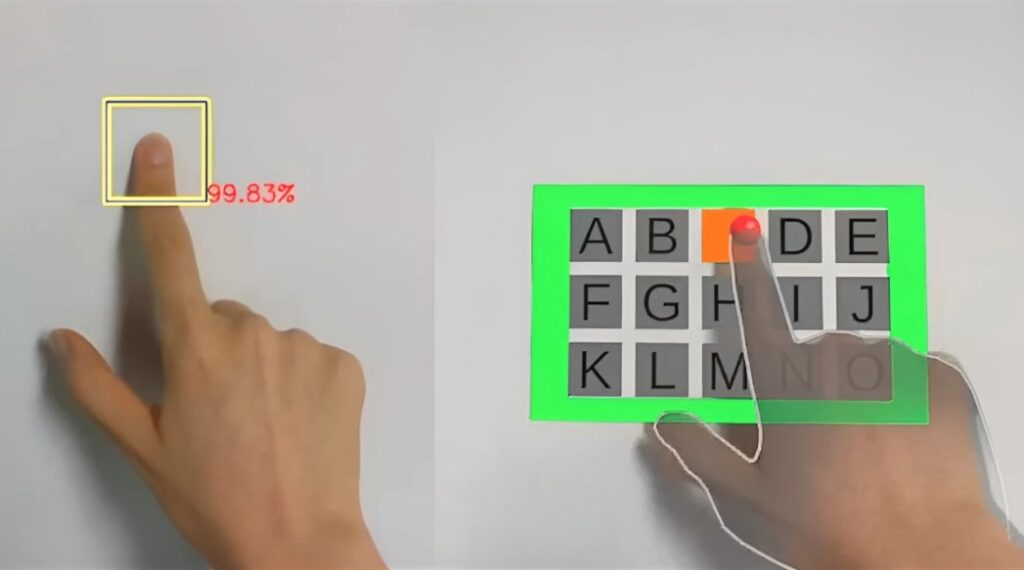
A new augmented reality (AR) technique is redefining how users interact with virtual interfaces by turning ordinary surfaces into touch panels. Reported by New Atlas, the system leverages a natural physical response known as fingertip blanching, the temporary whitening of skin when pressure is applied, to detect touch input on real-world objects.
Existing AR systems often rely on handheld controllers or specialized gloves to register user input. These approaches can feel unnatural and physically tiring, especially when users must interact with floating virtual panels in midair. The new method eliminates those constraints by allowing users to tap directly on surfaces such as walls, desks, or partitions, providing a more intuitive and physically grounded experience.
Developed by researchers at Tohoku University, the system uses the camera already built into an AR headset to monitor the user’s fingertip. When the finger presses against a surface, the blanching effect alters its appearance. AI-driven algorithms detect this visual change and determine the exact moment and location of contact relative to a projected virtual interface.
This approach removes the need for additional sensors, markers, or wearable devices, simplifying both hardware requirements and user interaction. It also introduces a tactile dimension absent in many AR systems, as users physically touch surfaces rather than gesturing in empty space.
Beyond convenience, the system could improve accuracy and reduce user fatigue. By allowing hands to rest on surfaces, it supports more stable and prolonged interaction, which is particularly important for tasks such as typing or precise control. Early demonstrations show that the technique can reliably detect input across a range of common materials.
The research highlights a broader trend in AR development: embedding interaction into the physical environment rather than isolating it in virtual space. By using the body’s natural responses as input signals, engineers are moving toward interfaces that feel less like tools and more like extensions of everyday behavior.
