

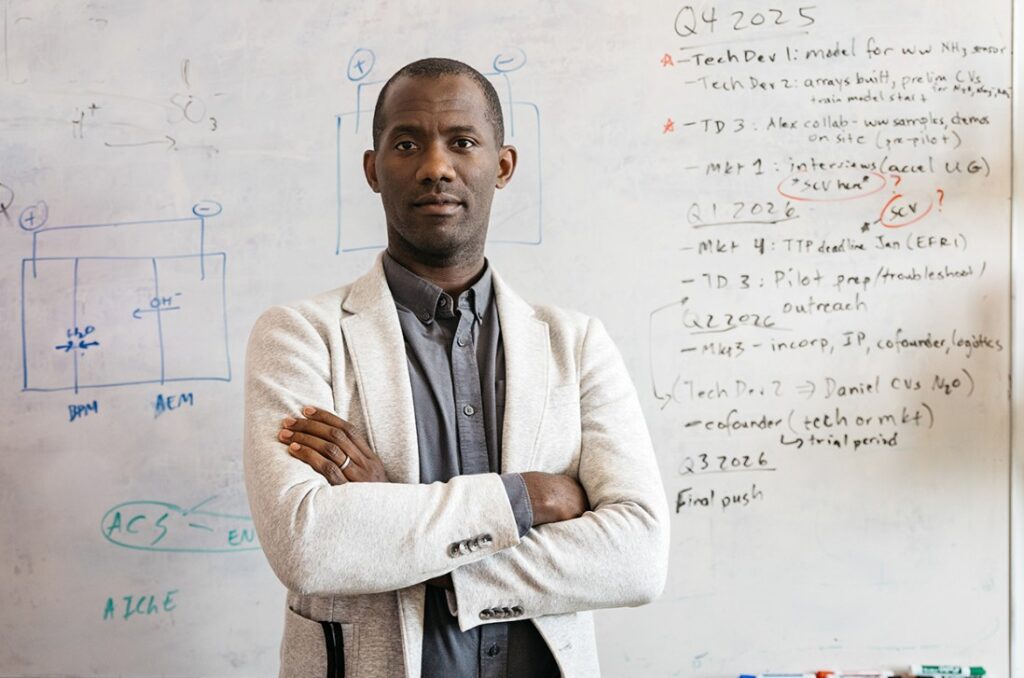
William Tarpeh, an assistant professor of chemical engineering at Stanford, was awarded a 2025 MacArthur Fellowship in recognition of his pioneering work on resource recovery from wastewater. The fellowship carries a grant of $800,000 over five years and rewards originality, dedication, and potential for impact, says StanfordReport.
Tarpeh’s research focuses on reclaiming nitrogen, sulfur, and phosphorus from waste streams—elements that are both environmental hazards when released untreated and critical for fertilizers, industrial chemicals, and clean energy applications. Conventional wastewater treatment often discards or dilutes these nutrients, but Tarpeh has engineered electrochemical systems and selective membranes that separate and convert them into usable chemicals.
One of his notable devices is an Electrocatalyst-in-a-Box (ECaB) system, which extracts ammonia directly from municipal wastewater streams and converts it into products like ammonium sulfate. Tarpeh also works on recovering lithium from spent batteries, a task important for the clean energy transition. These methods are designed to be low-energy and scalable, so they can work even in places with limited infrastructure.
At Stanford, Tarpeh holds courtesy appointments in civil and environmental engineering and is affiliated with several environmental institutes. His approach reframes wastewater not as a disposal problem, but as a resource loop; waste streams can become on-site production hubs for chemicals and nutrients.
The MacArthur award underscores the societal promise of his work, a vision in which communities recover the very resources they once discarded. It also gives Tarpeh the flexibility to scale pilot systems, refine efficiency, and explore new chemical recovery frontiers.
