

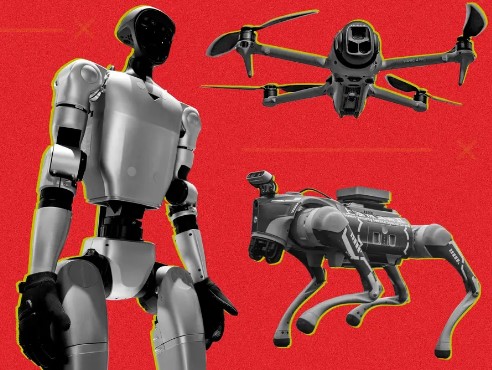
A proposed U.S. ban on Chinese-made robots signals a growing shift in how governments approach technology competition, particularly in emerging sectors such as robotics. The legislation, known as the American Security Robotics Act, aims to restrict U.S. government agencies from purchasing or using ground robots built by Chinese companies, including humanoid systems and robotic platforms used for inspection and security, tells IEEE Spectrum.
The move reflects broader concerns about national security and data privacy. Lawmakers argue that connected robotic systems could potentially transmit sensitive data or be remotely accessed, creating risks in environments where robots interact with critical infrastructure or public services.
However, the proposal exposes a deeper tension within the robotics industry. While banning Chinese competitors at the final product level may benefit some U.S. firms, many American robotics companies still rely heavily on Chinese-made components within their supply chains. This creates a complex dependency, where cutting off access to Chinese technology could disrupt domestic production and slow industry growth.
The issue is further complicated by the current state of the robotics market. Unlike mature sectors such as semiconductors, ground robotics remains in an early stage of adoption, with fragmented supply chains and limited production capacity outside key regions. Countries such as Japan and South Korea supply critical components, but replacing China’s manufacturing scale would require significant time and investment.
The proposed ban is also part of a broader pattern of technological decoupling between the United States and China. Similar restrictions have already been applied to drones, telecommunications equipment, and other strategic technologies, reflecting a bipartisan push to reduce reliance on foreign systems in sensitive domains.
Ultimately, the debate highlights a fundamental challenge. Efforts to secure technology ecosystems must balance national security with economic and industrial realities. In robotics, where global supply chains are deeply interconnected, policy decisions can have unintended consequences.
The situation underscores a larger transition. As robotics becomes more central to industry and defense, it is no longer just an engineering field but a strategic battleground, where technology, policy, and geopolitics are increasingly intertwined.
