

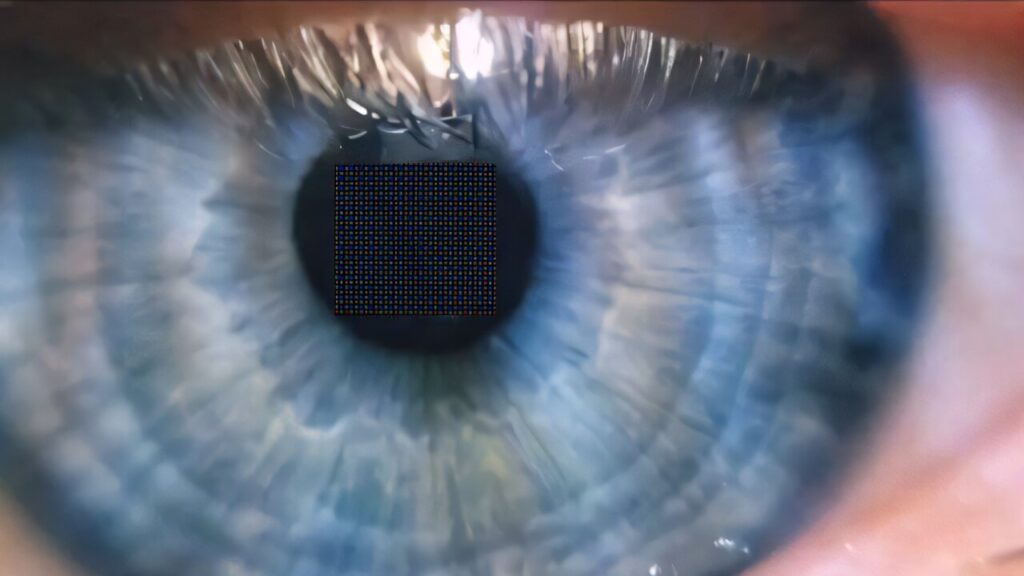
A research team from Chalmers University of Technology, University of Gothenburg, and Uppsala University in Sweden has developed a novel display technology dubbed “retina E-paper” that pushes pixel density to the upper limit of human vision. In their publication in the journal Nature, they detail how each pixel is about 560 nm across, and the resulting display exceeds 25,000 ppi (pixels per inch), a resolution at which humans cannot meaningfully distinguish finer detail, tells Tech Xplore.
The display uses nanoparticles of tungsten oxide that scatter and reflect incident light; by arranging and sizing these particles precisely, the researchers achieved full-color representation (red, green, blue) and electrical tunability (pixels can be switched off to black). Importantly, the display is reflective (i.e., passive) rather than emissive, meaning it relies on ambient light rather than backlighting, which can reduce power consumption and enable very close-viewing use-cases.
To demonstrate the tech, the team reproduced the art piece The Kiss by Gustav Klimt on a surface area of about 1.4 × 1.9 mm, roughly 1/4000th the size of a standard smartphone screen. This compact scale suggests applications in virtual reality (VR), augmented reality (AR), near-eye displays, and other immersive tech where pixel density and closeness of display to the eye are critical.
While the work is major, the researchers still describe it as a step rather than a finished product. Further tuning and scaling will be needed to bring the technology into consumer or industrial production. For engineering audiences, the takeaway is clear: the pixel-size bottleneck for realistic near-eye displays may be nearing its theoretical limit, but attention will now shift to manufacturing, materials engineering, and system integration for immersive display systems.
