

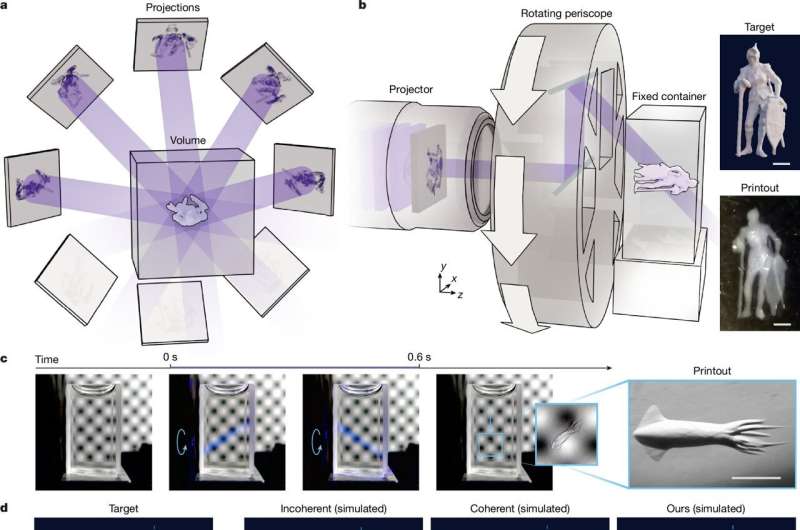
Researchers from Tsinghua University in China have unveiled a breakthrough 3D printing method that dramatically accelerates additive manufacturing, tells Tech Xplore. Traditional 3D printing builds objects layer by layer, often taking minutes to hours for detailed, millimeter-scale parts. The new system, called Digital Incoherent Synthesis of Holographic Light Fields (DISH), sidesteps that process by using rapidly changing holographic light patterns to polymerize resin in three dimensions at once. With this approach, complex shapes can form in just 0.6 seconds, orders of magnitude faster than most existing techniques.
DISH works by projecting light into a static, low-viscosity resin from many directions using a high-speed rotating periscope and a digital micromirror device. Those tiny mirrors flip patterns of light at roughly 17,000 times per second, while a custom algorithm determines how to concentrate exposure where needed to build the object and keep the rest of the resin unaltered. By eliminating the need to spin or vibrate the resin itself, the method avoids the instability problems that have slowed earlier high-speed volumetric printers.
In demonstration prints, the team produced detailed objects such as miniature statues and intricate gear-like components in under a second. They also showed that DISH can operate in a flow setup, pumping light-sensitive resin through a tube and curing structures on the move. This speeds sequential production and hints at the potential for high-throughput manufacturing lines for small parts.
The researchers see broad possibilities for this technology. Because it combines sub-second fabrication with fine resolution and sharp feature definition, it could be useful in fields ranging from photonics and micro-robotics to biomedical applications such as printing vascular-like structures or other tissue-mimicking components. If translated into scalable systems, DISH could challenge conventional additive manufacturing by offering near-instant production of complex, customized objects.
