

Replicating the human hand’s dexterity has long challenged robotics, largely because of the complexity beneath the skin. The MIT News article describes a new wearable wristband that uses ultrasound imaging and artificial intelligence to capture and translate hand movements with remarkable precision.
The device works by continuously imaging the muscles, tendons, and ligaments in the wrist as a person moves their hand. These internal structures act like “strings” that control finger motion. By analyzing these patterns, the system can infer the exact position of each finger and the palm in real time.
An AI model plays a central role by converting ultrasound images into motion data. The system is trained on individual users, learning how their specific hand movements correspond to changes in wrist anatomy. Once trained, it can instantly map gestures to digital commands, enabling seamless interaction with robotic systems or virtual environments.
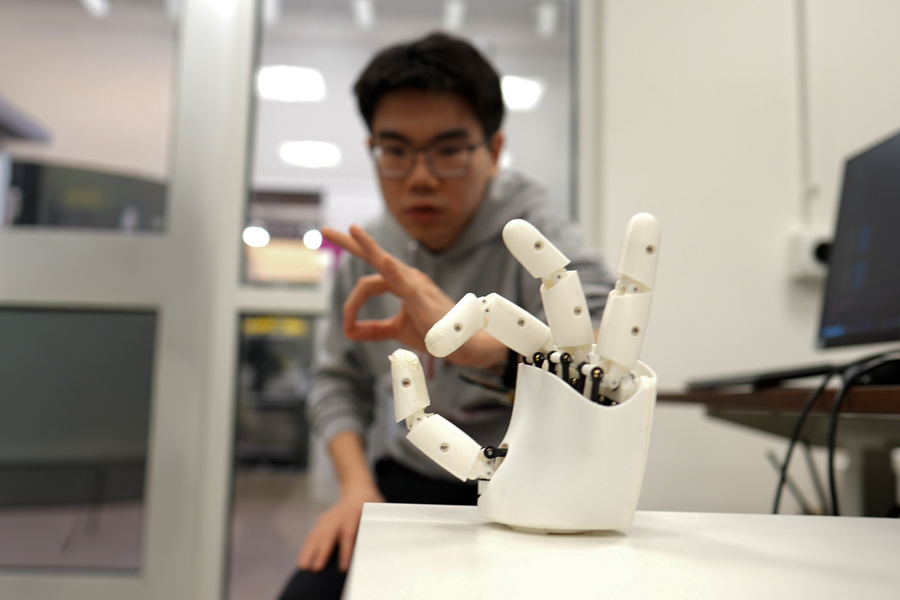
In demonstrations, users wearing the wristband wirelessly controlled a robotic hand that mirrored their actions. Simple gestures allowed the robot to perform tasks such as playing a piano tune or shooting a small basketball. The same interface also enabled users to manipulate virtual objects, such as resizing images with pinching motions.
Compared with existing methods, the wristband addresses key limitations. Camera-based tracking can be obstructed or require complex setups, while sensor gloves can restrict natural movement. Electrical signal approaches often lack the sensitivity to capture subtle, continuous motion. Ultrasound imaging provides a more detailed and stable signal, enabling finer control.
Beyond direct control, the technology could generate large datasets of human hand movements. These datasets may help train humanoid robots to perform complex tasks requiring fine motor skills, including surgical procedures or intricate assembly work.
The research points to a broader shift in human–machine interfaces. By capturing motion at the level of muscles and tendons, the wristband offers a more natural and precise way to bridge human intent and robotic action, opening new possibilities in robotics, virtual reality, and assistive technologies.
