

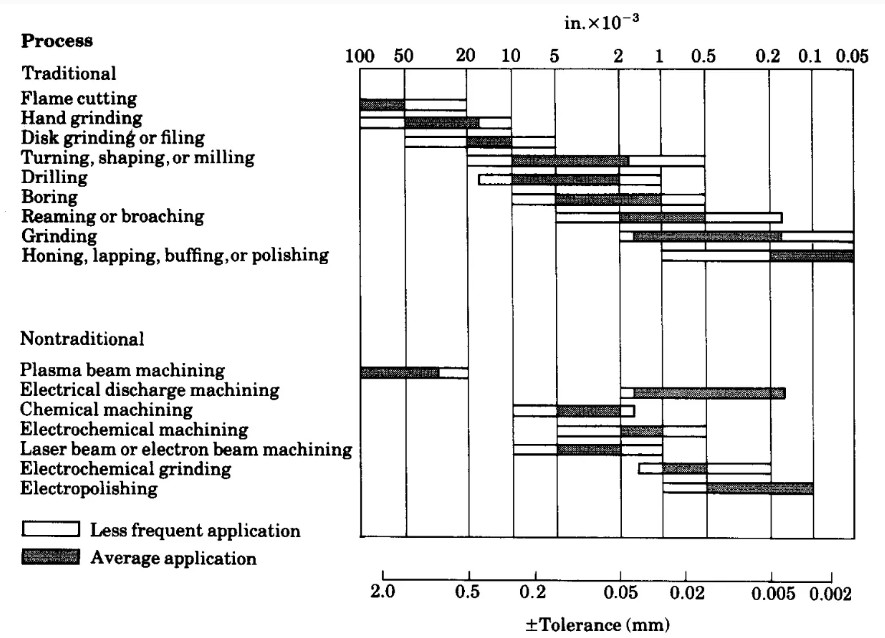
The Hardware FYI article mentions the “Typical Tolerances of Manufacturing Processes” document from the University of Florida, which explains the role of tolerances in mechanical design and what realistic values can be expected from common manufacturing methods. It opens by noting that many engineering students can place tolerances on CAD drawings, but struggle to choose appropriate numbers that fit real-world manufacturing. Tolerance values matter because they directly affect both part function and production cost. Recognizing this gap, the course provides insights into tolerances achievable through milling, turning, drilling, reaming, sawing, and similar processes, and outlines how to think about tolerances relative to part size and process capability.
The document includes charts that illustrate typical tolerances for manufacturing processes. These charts show average capabilities—the shaded ranges represent tolerances most shops can regularly achieve, while the extremes require highly skilled operators and excellent equipment conditions. One key takeaway is that precision comes at a cost. Trying to hold very tight tolerances increases machining time and cost, and in many cases is unnecessary if a looser tolerance already satisfies functional requirements.
A related section discusses how measuring instruments themselves have accuracy limits that impact tolerance decisions. For example, a pair of 6-inch calipers may have an error margin of ±0.001 inch per inch of measurement. If a design demands a ±0.005-inch tolerance on a 10-inch part, the tool’s own error becomes a significant source of uncertainty. Designers must account for such measurement limitations when specifying tolerances.
The document also highlights the relationship between surface finish and production time. Finer surface finishes generally require more machining time, and tolerance requirements should be justified in terms of function. Understanding common process capabilities and the implications of tighter tolerances helps engineers balance design intent with manufacturability and cost.
