

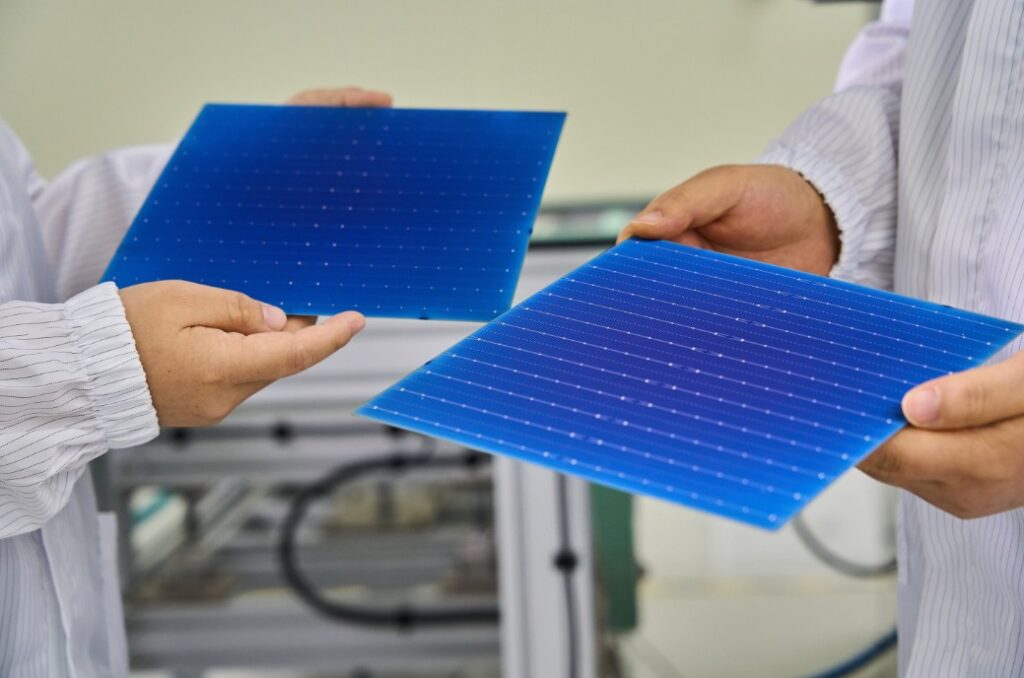
A recent study led by researchers at the Korea Institute of Energy Research (KIER) and Chungbuk National University (CBNU) has cracked a long-standing mystery in silicon heterojunction (SHJ) solar cells: the real nature of the defects that degrade their efficiency, tells Tech Xplore. Using a refined method based on traditional Deep Level Transient Spectroscopy (DLTS), the team captured the full transient response of the cells rather than just two snapshots before and after a voltage pulse. This allowed them to distinguish two separate defect populations instead of assuming a single defect type.
The two identified defect classes are: a slow, deep-level defect and a fast, shallow-level defect. By isolating each, the researchers measured critical parameters such as defect energy levels, spatial distribution within the device, and atomic bonding configurations.
Interestingly, these defects can transform depending on fabrication conditions or device operation, influenced by the hydrogen present in the cells. That means even the final performance depends on process control and environment.
This insight matters because defect passivation, i.e., coating or treating cell surfaces to neutralize defects, can now be better targeted. Rather than “one-size-fits-all,” passivation schemes can be tailored to address both shallow and deep defects quantitatively and qualitatively.
More broadly, this refined analysis technique isn’t limited to solar cells. It could be applied across other semiconductor devices such as LEDs, sensors, or CMOS chips, any system where performance degrades due to hidden or complex defect dynamics.
The research opens a path to more efficient, defect-aware manufacturing of SHJ solar cells, and perhaps beyond.
