

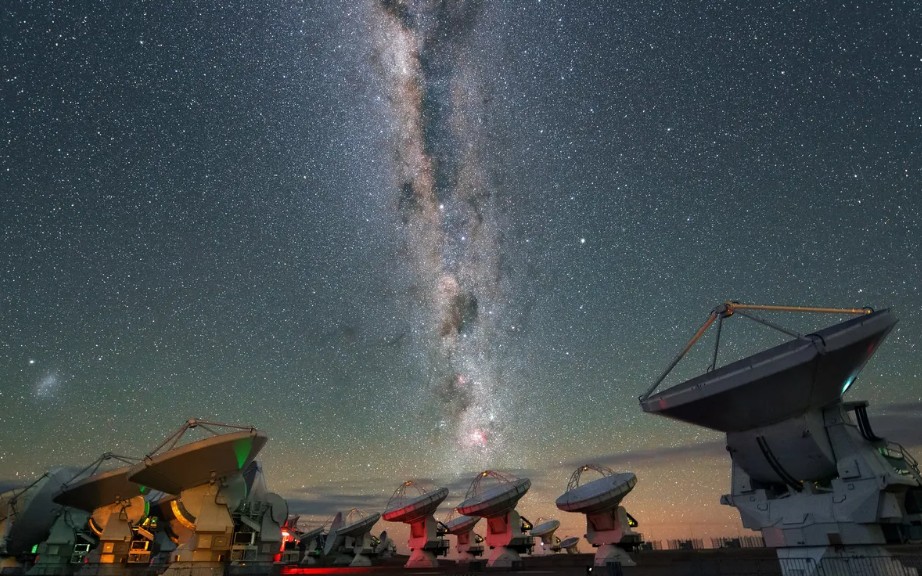
The Atacama Large Millimeter/submillimeter Array (ALMA), one of the world’s most sensitive radio telescopes, has received a significant upgrade with the installation of 145 new low-noise amplifiers (LNAs), tells IEEE Spectrum. Located on the high desert plateau of northern Chile, ALMA uses 66 parabolic antennas to observe millimeter and submillimeter wavelengths emitted by cold gas and dust in space. These emissions cannot be seen with optical telescopes but carry critical information about star formation, planet-forming disks, and the interstellar medium.
The newly installed LNAs extend ALMA’s ability to collect data in “Band 2,” which covers wavelengths corresponding to frequencies from about 67 to 116 GHz. Before this upgrade, ALMA’s receivers covered 10 discrete frequency ranges, but the addition of Band 2 means astronomers can observe a broader slice of the electromagnetic spectrum with greater sensitivity. The LNAs achieve this by using advanced semiconducting materials and high-electron-mobility transistor technology to amplify weak cosmic signals with minimal noise contribution.
Low noise in the first amplifier stage is essential because any noise added early in the signal chain degrades overall data quality. The new LNAs have an average noise temperature of around 22 K, which is among the lowest achieved worldwide. This lets ALMA amplify incoming signals more than 300-fold without swamping them with electronic interference.
With these enhancements, researchers expect improved views of the cold interstellar medium, the clouds of gas and dust where stars form, and finer detail on the structure of planet-forming disks around young stars. The extended frequency coverage also opens the door to detecting complex organic molecules in galaxies beyond our own, molecules that are considered building blocks for life.
This upgrade keeps ALMA at the forefront of radio astronomy, enabling deeper exploration of cosmic origins and the mechanisms that shape stars and planetary systems.