

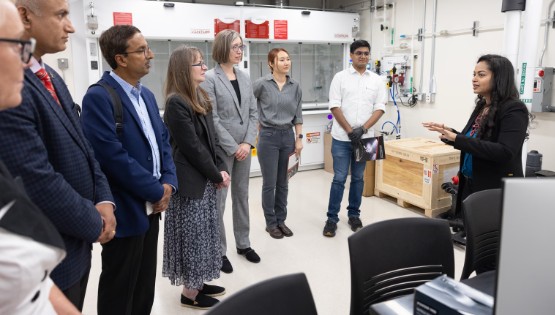
UW-Madison unveiled its Ultra-Wide Bandgap Semiconductor MOCVD Laboratory in the Engineering Centers Building, marking a leap forward in campus research infrastructure. Led by Assistant Professor Shubhra Pasayat, with support from ECE Chair Susan Hagness, Dean Devesh Ranjan, and national partners like NatCast, the lab brings capabilities rarely found at universities, reports College of Engineering, University of Wisconsin-Madison.
Traditional silicon semiconductors are hitting their physical limits in energy, frequency, and temperature. That’s why UW-Madison is zeroing in on III-nitride materials, specifically ultra-wide bandgap types such as aluminum gallium nitride (AlGaN) and aluminum nitride (AlN), which can operate under extreme heat, high voltages, and radiation, along with next-gen demands such as 6G communication and hypersonic environments.
The real game changer is the lab’s Agnitron Agilis 100 MOCVD reactor. It operates at higher temperatures and lower pressures than UW’s previous Aixtron system, enabling precise synthesis of high-aluminum-content AlGaN and AlN on two-inch wafers. That unlocks new experimental reach, fosters cross-campus collaborations, and draws industry interest, all while equipping students with hands-on experience using cutting-edge fabrication tools.
Over in Pasayat’s lab, UW’s growing III-nitride ecosystem now spans design, fabrication, characterization, packaging, and systems integration, basically taking ultra-wide bandgap semiconductors from theoretical designs to real-world motherboards, without leaving campus.
The MOCVD Lab is both a technical powerhouse and a talent engine. It cements UW-Madison as a major hub for next-generation semiconductor research and primes it for innovation that moves fast, from lab bench to real-world impact.
