

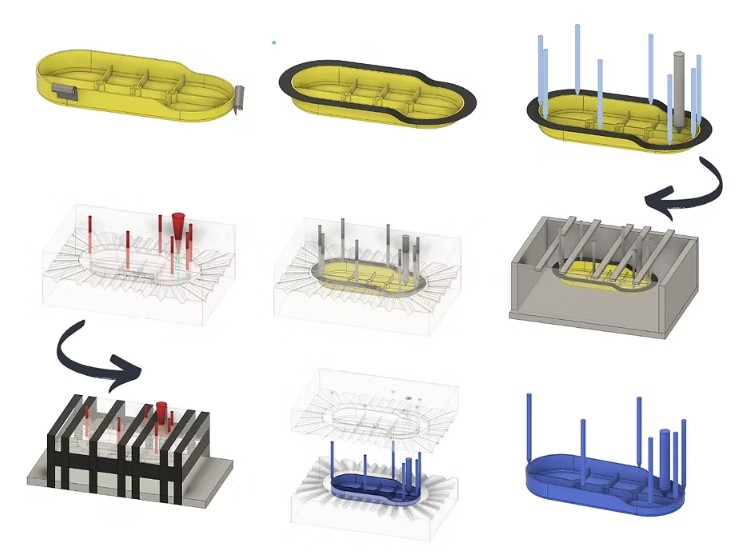
Vacuum casting is a widely used manufacturing technique for producing accurate prototypes and small batches of parts with excellent surface finish and dimensional detail, explains this article from Zaid McAllister’s blog. The process relies on silicone molds and liquid casting resins, typically polyurethane, to replicate a master model with high fidelity. Because silicone tooling is relatively inexpensive and fast to produce, vacuum casting has become a popular method in product development when companies need functional prototypes before committing to large-scale manufacturing.
The process begins with the creation of a master model. This model serves as the blueprint for all subsequent parts and, therefore, requires precise geometry and a smooth surface finish. Engineers typically design the model using CAD software and fabricate it using technologies such as SLA 3D printing or CNC machining. Any imperfections in the master will transfer directly to the final parts, so sanding, polishing, or coating is often performed to achieve the desired surface quality.
Once the master model is complete, technicians prepare a silicone mold around it. The model is placed inside a mold box and liquid silicone is poured around it. The assembly is then degassed in a vacuum chamber to remove air bubbles that might affect the mold quality. After the silicone cures, the mold is carefully cut open, and the master model is removed, leaving a flexible cavity that replicates the original design.
The casting stage follows. Liquid resin is mixed and degassed before being poured into the silicone mold inside a vacuum casting machine. The vacuum environment eliminates trapped air and ensures the material fills fine details and complex geometries. The filled mold is then heated or left to cure until the resin solidifies.
Finally, the molded part is removed and finished. Excess material from sprues or vents is trimmed, and additional processes such as painting or surface coating may be applied. Because a single silicone mold can produce multiple copies, the technique is well-suited for rapid prototyping and low-volume production runs where speed, cost, and surface quality are critical.
