

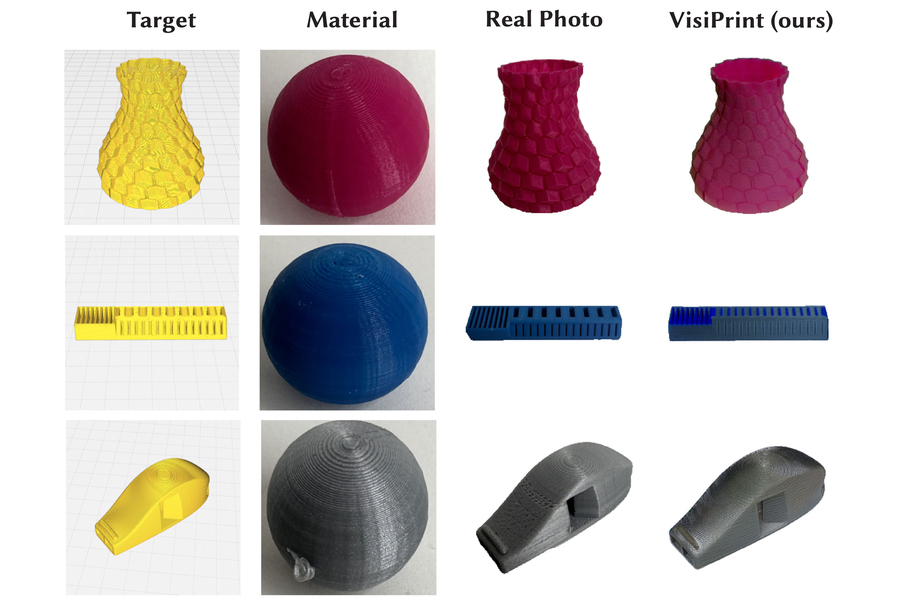
A persistent challenge in 3D printing is the gap between digital design and physical outcome. The MIT News article introduces a new system, VisiPrint, that addresses this issue by generating highly accurate visual previews of objects before they are fabricated.
Traditional 3D printing software focuses primarily on functional aspects such as geometry and structural integrity, often overlooking appearance. As a result, printed objects can differ significantly in color, texture, or finish from what users expect. This mismatch frequently leads to repeated prints, increasing material waste, time, and cost.
VisiPrint shifts the focus toward aesthetics. Users provide two simple inputs: a screenshot of their design from standard slicing software and an image of the intended print material. From these, the system uses artificial intelligence to generate a realistic rendering of the final object.
The tool accounts for complex factors that influence appearance in fused deposition modeling, the most common 3D printing method. These include how melted material behaves during extrusion, the layering process, and the path of the printing nozzle. By analyzing material properties such as color, gloss, and translucency, the system predicts how these variables will interact during fabrication.
Two AI models work together to achieve this. A computer vision model extracts key visual features from the material sample, while a second model integrates this information with the geometry of the design to produce a realistic preview. The result is an “aesthetics-first” visualization that closely matches the final printed object.
The implications extend across multiple fields. In dentistry, for example, clinicians could ensure that temporary crowns match the appearance of natural teeth. In architecture and product design, teams could better evaluate visual outcomes before committing to fabrication.
Beyond improving accuracy, the tool addresses sustainability. Studies suggest that up to one-third of 3D printing material can be wasted due to discarded prototypes. By reducing trial-and-error iterations, VisiPrint offers a way to make additive manufacturing more efficient and less resource-intensive.
The research reflects a broader shift in digital fabrication. As AI tools become more integrated into design workflows, they are not only improving performance but also bridging the gap between virtual models and physical reality.
