

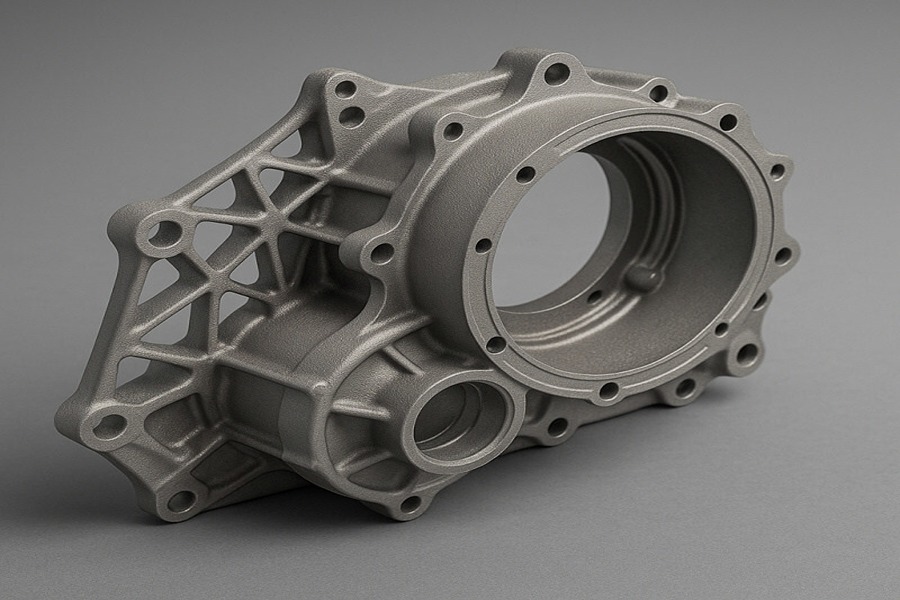
PALO ALTO, CA, Aug 18, 2025 – Vittori has entered a production partnership with Totum 3D and ShapeUp Studios to manufacture titanium 3D-printed components. The collaboration spans a three-phase roadmap that starts with hypercars and moves into eVTOL and electric jet programs, linking road and air development.
The partnership spans design-for-additive reviews, rapid prototyping, and pilot runs of 3D-printed parts. Each material is tied to a specific role. Titanium delivers strength-to-weight. Stainless and maraging steels handle heavy loads. Aluminum alloys keep structures light. Nickel superalloys withstand hot zones. Copper alloys manage cooling hardware. Aerospace polymers such as PEEK and ULTEM meet cabin-safety needs. (examples include 316L and 17‑4PH stainless, AlSi10Mg and Scalmalloy aluminum, Inconel 718, and CuCrZr). For larger assemblies, printed parts are paired with carbon-fiber panels and honeycomb cores. Cabin-facing materials will undergo qualification for flame, smoke, and toxicity standards – mandatory in aviation industry.
“As others explore aerospace concepts, we’re putting titanium parts into production now,” said Carlos Cruz, founder of Vittori. “Proving hardware on the road first lowers risk and speeds our move to the air. The same printed structures and thermal systems will migrate into our eVTOL and, later, our electric jet.””Vittori’s road‑to‑air plan is a strong fit for metal additive,” said Stefano Turconi, Head of Totum 3D. “Common, lightweight architectures reduce part count and lead time while meeting demanding performance targets.”
Vittori plans to unveil the Turbio, an AI-hybrid hypercar equipped with a V12 engine targeted at approximately 1,100 horsepower and 3D-printed titanium parts, on Oct. 4, 2025. The launch event will be held in partnership with Pininfarina. This announcement coincides with Vittori’s fundraising to support prototype development and its transition from road vehicles to air mobility.
Source: Vittori
About Vittori

Vittori, founded in 2025 and headquartered in Palo Alto, CA, develops AI-powered, additively manufactured vehicles with a focus on automotive design. The company’s flagship project, the Turbio hypercar, combines a 6.5-liter V12 hybrid engine with a lithium-ion electric drivetrain, producing about 900 horsepower and 1,900 newton-meters of torque. Designed for both speed and efficiency, the Turbio accelerates from zero to 60 mph in roughly 2.5 seconds and reaches a top speed of more than 220 mph. Vittori uses materials such as carbon fiber and leverages AI-driven 3D printing to optimize lightweight structures and aerodynamics. Limited production is planned, with only 50 units offered through pre-sales, positioning the vehicle in the ultra-luxury performance segment. The company is in early-stage development, concentrating on precision engineering and exclusive customer offerings.
About Totum 3D

Totum 3D, headquartered in Rescaldina, Italy, provides additive manufacturing services including 3D printing, consulting, reverse engineering, and supply chain support. The company operates more than 30 printers and works with over 100 materials across technologies such as fused deposition modeling (FDM) and digital light processing/stereolithography (DLP/SLA). Totum 3D serves industries including energy and environmental sectors, industrial manufacturing, automotive, nautical, aerospace, and fashion and design. Its offerings cover part modeling, functional and dimensional testing, production, and delivery, supported by quality control processes. By focusing on customization, scalability, and process digitization, the company helps customers reduce costs, shorten lead times, and minimize waste across supply chains.
About ShapeUp Studios

ShapeUp Studios, headquartered in Italy, provides 3D-enabled product development services with a focus on design concepting, modeling, and project presentations. The company supports sectors including automotive, aerospace, industrial design, and luxury goods by combining creative design research with technical expertise to balance aerodynamics, lightweight construction, and surface finishes. Its work integrates digital tools to help manufacturers transition from concept to production-ready prototypes, emphasizing both functional performance and visual appeal. ShapeUp Studios has also collaborated on projects in mobility and performance engineering, contributing design capabilities that align with manufacturing methods such as additive production and composite material use.
