

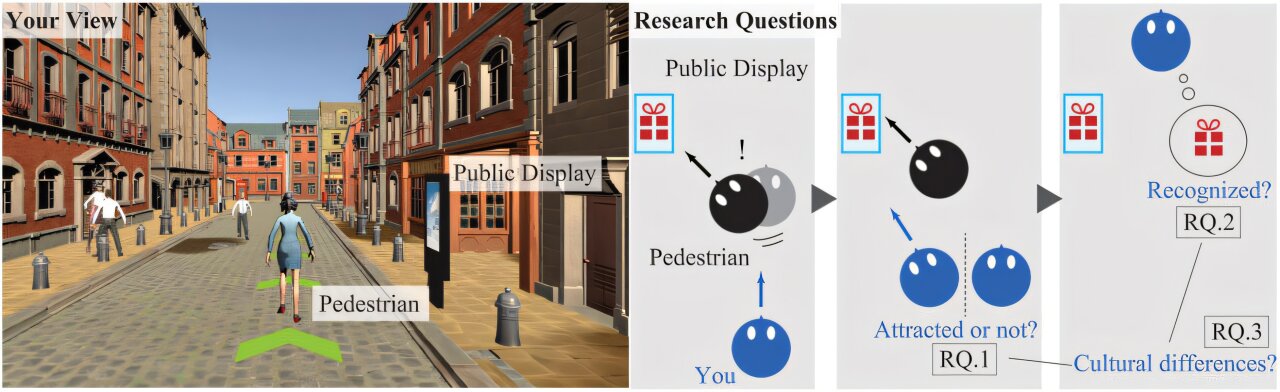
Researchers at the University of Tsukuba used virtual reality to explore how pedestrian behavior influences attention to public displays, demonstrating a social phenomenon called the honey-pot effect, tells Tech Xplore. In real urban environments, people often overlook static billboards and digital signage. The honey-pot effect describes a situation in which one person’s attention to a display draws the gaze of others walking nearby. Through a controlled VR simulation recreating a typical sidewalk with a static display, the study examined whether simple behaviors by a virtual pedestrian, such as stopping or turning toward a screen, would affect where participants directed their attention.
In the experiment, participants walked behind an avatar that behaved in one of three ways: passing by without looking, briefly glancing at the display, or stopping in front of it. When the avatar stopped and clearly focused on the display, participants were significantly more likely to turn their heads toward it, suggesting that visible cues from others can increase awareness of nearby screens. A similar effect occurred when an oncoming pedestrian avatar looked at the display, indicating that both body orientation and gaze direction can propagate attention. These findings show that even minimal social cues can influence where people look in crowded settings.
However, despite increased attention, brief viewing times typical of walking pedestrians were generally insufficient for participants to recall the display’s content with accuracy. In other words, noticing a screen did not necessarily translate into remembering what it showed. The study also found no significant differences in attention patterns between German and Japanese participants, suggesting that the honey-pot effect operates similarly across these cultural groups in this context.
Importantly, the research demonstrates that VR can safely and accurately model real-world pedestrian behavior for systematic study, a tool that could inform the placement and design of public displays or signage. By using avatar-mediated cues in virtual environments, designers might better understand how social dynamics affect attention and improve the effectiveness of urban information systems.
