

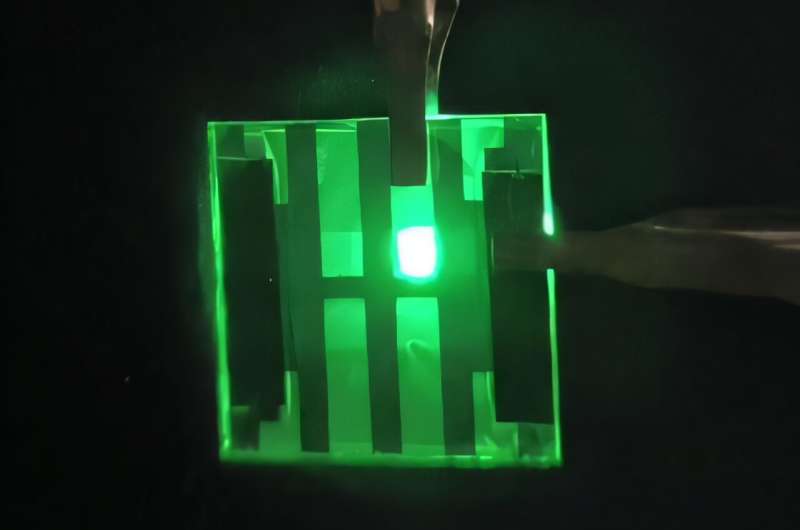
Researchers announced a breakthrough in lighting: a quantum-dot white LED, just tens of nanometers thick in its emissive layer, that closely mimics the solar spectrum. This ultra-thin device, described in ACS Applied Materials & Interfaces, holds promise for displays, interior lighting, and other applications where natural light quality and minimal form factor matter, tells Tech Xplore.
To replicate sunlight’s quality, the team engineered quantum dots emitting in red, yellow-green, and blue, and wrapped them in zinc-sulfur shells. They carefully tuned the proportions so the combined emission approximated sunlight, especially in the yellow and green bands where many earlier white LEDs fall short. The full LED stack includes conductive polymers, metal oxide particles, and a transparent substrate, yet remains dramatically thinner than conventional color conversion layers.
In performance tests, the prototype performed well under an 11.5 V drive, yielding a warm, strong white light. Its color rendering index (CRI) exceeded 92%, meaning objects illuminated appear true to life. The researchers also optimized the design to work at only 8 V in many devices while maintaining brightness. The spectral output has less blue emphasis, which is favorable from the perspective of circadian health and eye strain.
Potential applications are wide. Because of its thin form, the LED could be integrated into displays, panels, or even fabrics, i.e., surfaces that glow but don’t feel or look like a light fixture. It could enable ambient lighting that shifts with daylight or adaptive indoor lighting tuned to human comfort.
Challenges remain. Scaling production, ensuring long-term stability, power efficiency, and integration into consumer devices are nontrivial tasks. But this prototype shows it’s possible to bring the warmth and fidelity of sunlight into an ultra-thin form.
