

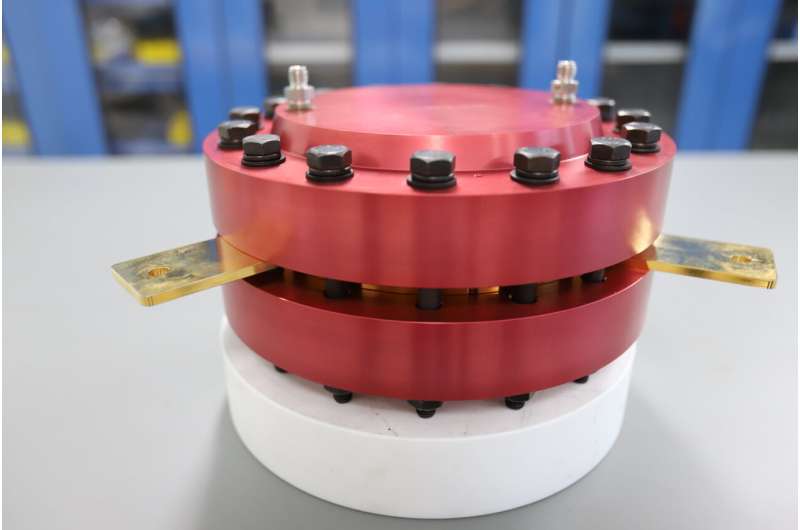
Researchers have developed a next-generation heat pump that transforms low-temperature waste heat into cooling, offering a more energy-efficient alternative to conventional air conditioning. Led by the Korea Institute of Machinery and Materials (KIMM) in collaboration with Chung-Ang University, the project addresses a long-standing challenge in using low-grade waste heat from factories and data centers. Instead of relying on electricity to compress refrigerants, the new system uses waste heat at temperatures as low as 40°C (104°F), significantly reducing electricity consumption while improving overall energy efficiency, tells Tech Xplore.
The research combines a chemical adsorption heat pump with an electrochemical compressor to achieve this breakthrough. KIMM developed the adsorption heat pump, while Chung-Ang University designed the electrochemical compressor, which operates without mechanical moving parts. Samjung Tech Co., Ltd. built a 10 kW prototype that successfully demonstrated the technology. Unlike conventional adsorption cooling systems that require heat sources above 70°C (158°F), the new system delivers effective cooling using much lower-temperature waste heat, expanding the range of environments where the technology can be deployed.
The team also redesigned the adsorption bed, the heart of the heat pump, achieving a specific cooling power of 346.5 W/kg. According to the researchers, this performance is more than twice that of comparable international technologies and represents a world-leading benchmark. The electrochemical compressor further improves efficiency by eliminating the noise and vibration associated with conventional mechanical compressors, making the system suitable for hospitals, schools, residential areas, and other noise-sensitive locations.
Another advantage is the use of ammonia as a natural refrigerant, helping the system comply with international refrigerant regulations while reducing its environmental impact. By capturing waste heat that would otherwise be discarded, the technology can improve the energy efficiency of factories, commercial buildings, and data centers, all of which generate substantial amounts of low-temperature heat.
The researchers are currently evaluating the 10 kW prototype through demonstration tests and plan to advance the technology toward field deployment. If successfully commercialized, the system could provide a practical way to reduce electricity demand, recover unused industrial energy, and deliver quieter, more sustainable cooling across a wide range of applications.
