

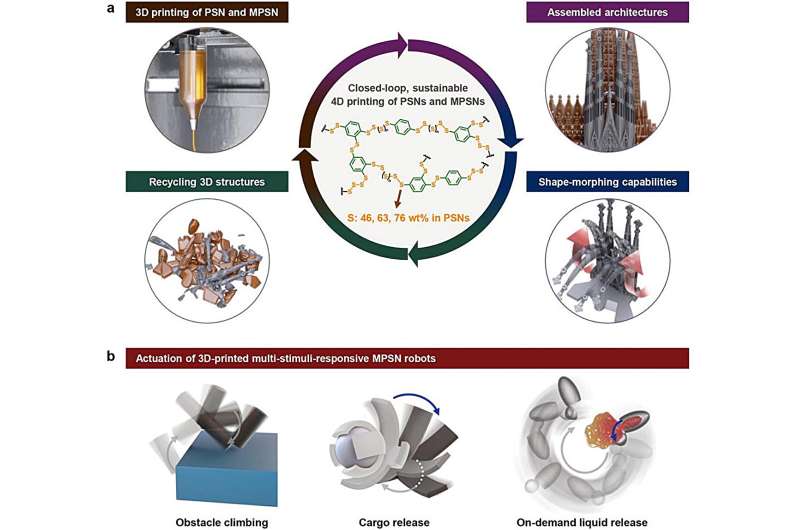
The Tech Xplore article reports a breakthrough that turns an abundant industrial by-product into a high-value material for advanced robotics. Researchers developed a sulfur-rich polymer system capable of 4D printing, where printed structures can change shape over time in response to external stimuli such as heat, light, or magnetic fields.
The work addresses a long-standing challenge: sulfur, produced in massive quantities during petroleum refining, has limited industrial use despite its abundance. By converting this material into functional polymers, the researchers position sulfur as a key resource in circular manufacturing. These sulfur-based plastics also offer unique properties, including infrared transparency and the ability to capture heavy metals, expanding their potential applications beyond robotics.
A major technical hurdle was the difficulty of processing sulfur polymers with conventional 3D printing methods, owing to their rigid internal structure. The team overcame this by engineering a loosely cross-linked network that improves flowability while maintaining structural integrity. This innovation enables the fabrication of complex geometries with embedded shape-memory behavior, allowing printed components to transform without mechanical actuation systems autonomously.
The technology also introduces a novel assembly method. Using a near-infrared laser, printed parts can be chemically welded together in seconds, forming strong bonds without adhesives. This approach allows modular construction of intricate structures, similar to assembling building blocks, and supports scalable manufacturing of adaptive systems.
In robotic applications, the addition of magnetic particles enables small, untethered devices to move and respond to external magnetic fields. These soft robots, measuring less than a centimeter, demonstrate controlled motion without onboard power sources, highlighting potential uses in constrained or sensitive environments.
Equally significant is the system’s full recyclability. The printed materials can be melted and reused entirely, creating a closed-loop process that aligns with sustainability goals.
Taken together, the research signals a shift in additive manufacturing, where waste materials, smart polymers, and programmable structures converge to enable adaptive, reusable, and environmentally conscious robotic systems.
