

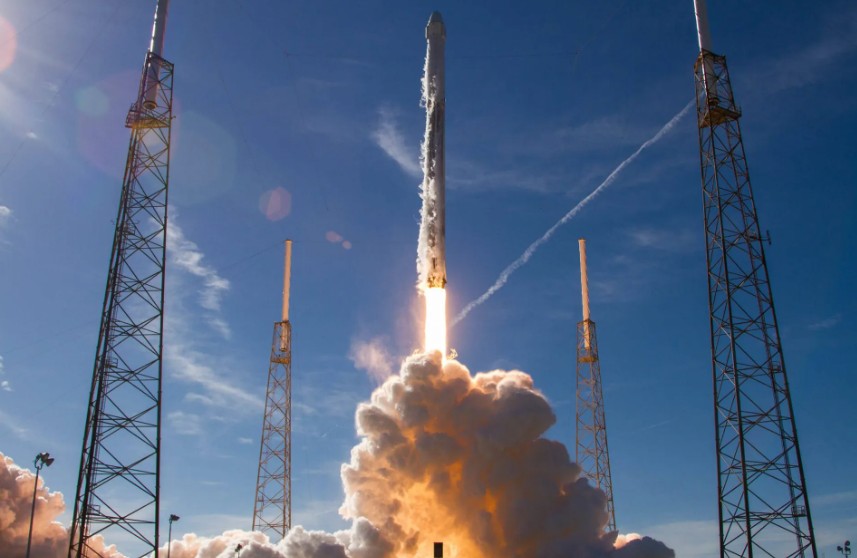
A young aerospace startup called General Galactic is attempting something that has never been done before in space: use water as rocket propellant on an orbital spacecraft, says Wired.com. The company, founded by former SpaceX and Varda Space engineers and backed with about $10 million in venture capital, plans to launch a roughly 1,100-pound satellite on a SpaceX Falcon 9 mission in late 2026 to test a water-based propulsion system. The goal of the Trinity mission is to prove that water can serve as the only fuel and oxidizer for both chemical and electric thrusters aboard a satellite, an approach that, if successful, could reshape refueling strategies and satellite maneuverability.
Current space propulsion falls into two broad categories: chemical rockets that burn fuels such as methane or hydrogen with an oxidizer to generate high thrust, and electric propulsion systems that ionize a gas such as xenon and accelerate it with electric fields for low-thrust but extremely efficient thrust over long durations. General Galactic’s concept uses water in both ways. In the chemical mode, water will be split into hydrogen and oxygen by electrolysis, with the hydrogen burned for thrust. In the electric mode, water is decomposed, and oxygen is ionized into a plasma that a Hall thruster can eject to produce efficient thrust.
Water is far easier to store and handle than cryogenic fuels, and it doesn’t boil off under sunlight exposure. That makes it attractive as a propellant, especially if derived in situ from ice on the Moon or Mars for future deep-space missions. General Galactic’s founders envision a future refueling infrastructure in cislunar space and beyond that could support sustained exploration.
However, experts caution that this idea still faces significant challenges. Ionized oxygen can corrode propulsion hardware, and the added mass of an electrolysis system may offset performance gains compared with conventional approaches. Despite these uncertainties, analysts say the Trinity mission’s demonstration could mark a notable step toward more sustainable and flexible propulsion systems for small satellites and future interplanetary missions.
