

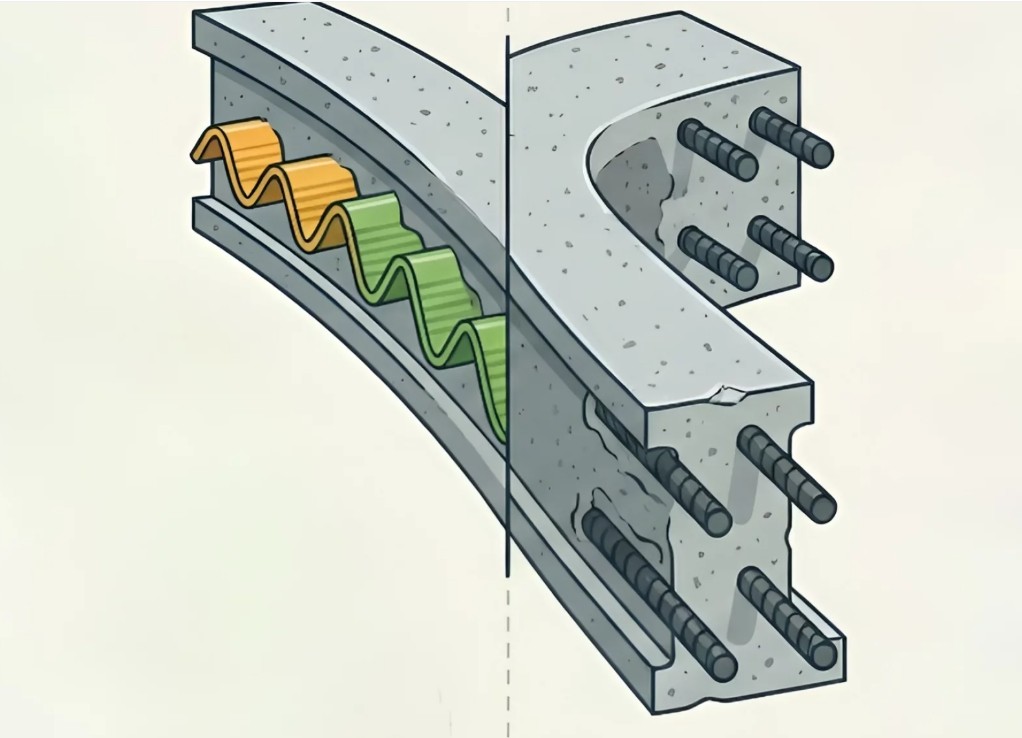
A team of researchers at the University of Sharjah is rethinking one of construction’s most established materials by exploring whether plastic, when engineered correctly, can rival steel reinforcement in concrete. Their work focuses not just on material substitution but on geometry, showing that shape plays a critical role in performance, tells New Atlas.
Concrete, the most widely used building material, relies on steel rebar to handle tensile forces and prevent cracking. While effective, steel introduces drawbacks including weight, corrosion risk, and a high environmental footprint due to energy-intensive production.
The researchers turned to polylactic acid, a biodegradable thermoplastic commonly used in 3D printing, and experimented with nontraditional reinforcement shapes. Instead of conventional cylindrical bars, they created flat plates, wavy patterns, and serrated geometries designed to increase surface area and improve bonding with concrete.
Testing revealed that geometry significantly influences performance. Plate-like structures doubled peak load capacity and increased energy absorption by up to five times compared to simple PLA bars. Wavy and triangular designs acted like interlocking teeth, enhancing grip and reducing slippage within the concrete matrix.
When compared with steel-reinforced concrete, the most effective configuration, triangular wavy plates, achieved up to 80% of steel’s bending strength while matching its ductility in certain tests. This suggests that carefully engineered plastic reinforcements could approach the structural performance of traditional materials, at least in controlled conditions.
Beyond mechanical performance, PLA offers advantages in sustainability and durability. It is lightweight, corrosion-resistant, and potentially lower in carbon impact. Additionally, 3D printing enables on-demand customization, allowing reinforcement designs tailored to specific stress conditions.
The findings remain preliminary, based on small-scale prototypes, but they highlight a broader shift in materials engineering. Instead of relying solely on stronger materials, designers are increasingly leveraging geometry to unlock new capabilities. In that context, plastic may not replace steel outright, but it could redefine how reinforcement is conceived in future construction systems.
