

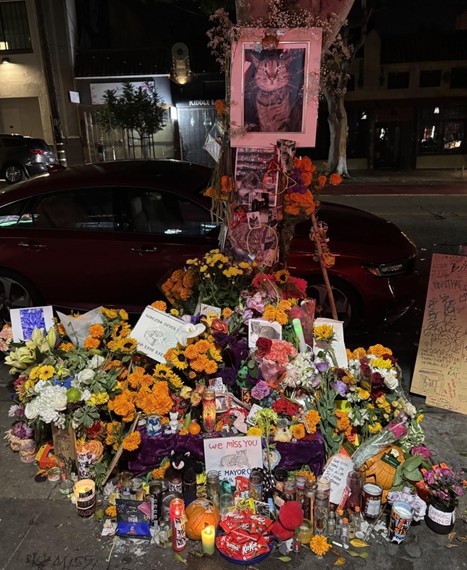
When a stray cat wandered into Randa’s Market in the heart of San Francisco’s Mission District six years ago, it was immediately hired as a mouser. The gray tabby was named KitKat for the candy-box that became its first bed. KitKat went far beyond the job description, greeting customers, even befriending their dogs. It quickly acquired local fame. Fans took selfies with KitKat, turned him into a Mission Street mascot. Photos of KitKat fill the store’s Instagram page.
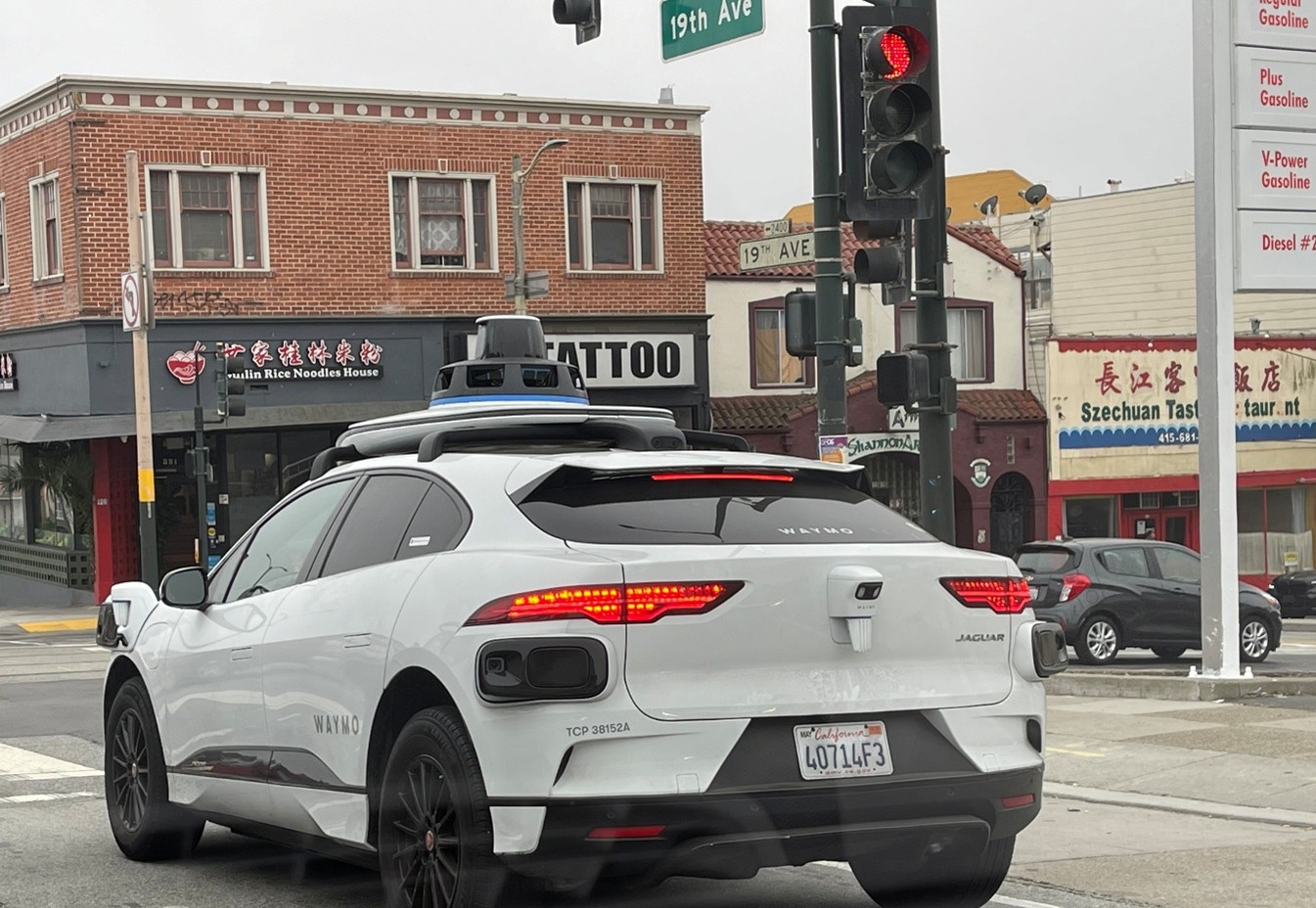
On the night of October 27, 2025, KitKat was crushed by a Waymo.
According to witness Jeff Klein, “a Waymo swerved in front of us at around 11:40 p.m. Some folks on the sidewalk started yelling and grabbed the cat right out from under where the Waymo swerved from.” That would would have been the bartender of the Delirium next door, according to a later article in The New York Times.
Waymo’s Carefully Worded Sympathy
“The trust and safety of the communities we serve is our highest priority. We reviewed this, and while our vehicle was stopped to pick up passengers, a nearby cat darted under our vehicle as it was pulling away. We send our deepest sympathies to the cat’s owner and the community who knew and loved him, and we will make a donation to a local animal rights organization in his honor.” — Waymo to SFGate
Of course, no driver was present. Therefore, responsibility must transfer to Waymo.
Ball One: The Dog Dies
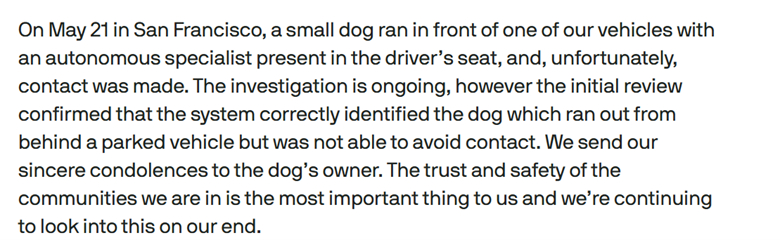
KitKat wasn’t the first pet killed by a Waymo. On May 21, 2023, a Waymo operating with a test driver at the wheel, struck and killed a small off-leash dog in San Francisco’s Bernal Heights neighborhood. Waymo’s response then:
“A small dog ran in front of one of our vehicles … We send our sincere condolences to the dog’s owner. The trust and safety of the communities we are in is the most important thing to us and we’re continuing to look into this on our end.” — Waymo to TechCrunch
Nearly identical wording. Same tone.
Waymo’s official statements may as well have generated by ChatGPT. To pet lovers, the donation would have sounded tone-deaf at best and evasive at worst. Nothing was said about compensation to KitKat’s owner. That omission may have been intentional, the statements issued with hope that a response recognizing no more than a loss of property, which under California Vehicle Code § 20002, an animal collision would indeed qualify, would be enough to put the matter to rest.
However, the law requires the driver to stop and report a pet death or risk a hit-and-run charge. Civil Code § 3340 also allows punitive damages if negligence is proven.
We’re not lawyers, but it would seem reasonable to assume that when there is no driver, the responsibility to act like a driver would transfer to the company operating the robotaxi.
Comfort Over Creatures
Inside the AV world, it’s quietly understood that robotaxis are tuned for rider comfort—which means avoiding hard braking or swerving except to prevent human injury. A jarring stop, even to save an animal, can trigger passenger complaints or insurance claims. The unspoken logic: it’s better for a rider to feel a bump and wonder “what was that?” than to be thrown forward by an emergency stop.
Strike One: Uber’s Fatal First
About a year before KitKat first wandering into Randa’s Market, a robotaxi had already killed a human. The first human death from a self-driving vehicle occurred in Tempe, Arizona on March 18, 2018, when a Volvo XC90 operating under Uber’s Advanced Technologies Group (ATG) struck and killed Elaine Herzberg. Hertzberg was walking her bicycle across a dark road. She was homeless.
That was strike one for robotaxis.
The Uber robotaxi programs was undergoing trials and operating with human backups at the wheel. The Volvo’s automatic braking had been disabled and full responsibility to stop the vehicle or perform evasive action in case of an impending collision had been given to the human backup. But on that fateful night, the human backup, was streaming The Voice on Hulu—an explicit rule violation. Had she been paying attention, police determined, the car would have stopped 42 feet before impact. The backup operator was later charged with negligent homicide but, in 2023, pleaded guilty to a reduced count of endangerment and received three years’ probation. Uber escaped criminal prosecution but quietly settled with Herzberg’s husband and daughter for a sum in the “low-millions.”
It was enough for state regulators to ride Uber ATG out of town. Not long after, Uber abandoned their plans for robotaxis — no doubt a big relief to the millions of drivers who depend on it for their income. Only two years ago (December of 2016), California had effectively kicked Uber out of San Francisco after the company refused to get a testing permit, according to Wired. Within hours of the California expulsion, Arizona’s governor, Doug Ducey tweeted, “California may not want you; but AZ does!”
Strike Two: The Cruise Catastrophe
San Francisco saw its second autonomous-vehicle tragedy on October 2, 2023, and robotaxis their 2nd called strike, when a Cruise robotaxi struck a pedestrian near Market Street after she had already been laid low by another (human-driven) vehicle. The Cruise vehicle, a Chevy Bolt EV, rolled forward, dragging her twenty feet before stopping.
Cruise withheld footage from investigators, prompting a scandal that cost its CEO his job and forced parent company GM to suspend robotaxi operations in San Francisco. Cruise was ridden out of town, before too long, the whole of Cruise’s robotaxi program was abandoned by GM.
The victim was to settle for between $8 million and $12 million, according to the Los Angeles Times.
City officials found fault with Cruise for initially hiding the video of the incidents and attempting somewhat of a cover-up.
Strike Three?
There are no flowers on Tempe’s Mill Avenue for Elaine Herzberg. We look away from the unhoused. They’re not cute, like KitKat.
The public mourning for KitKat underscores how sentiment can trump statistics. Models such as Quantifying the Impact of Deployments of Autonomous Vehicles and Connected Vehicle Technologies on Statewide Traffic Fatalities predict U.S. road deaths could drop 95 percent—from 57,700 in 2025 to under 3,000 by 2050—once AVs dominate. Yet one dead cat has done more to damage Waymo’s reputation than any white paper could repair.
San Francisco may seem like a city full of techies to outsiders, but for every coder there are ten non-tech workers. Here we find the help: the baristas, janitors, gig drivers, restaurant staff. They don’t order Waymos, they ride Muni, the municipal bus service. To order a robotaxi can all by itself expose the city’s deep divide between the haves and have-nots. It immediately signals a class difference. In that context, KitKat’s death is much more than the death of a street cat: it’s a rallying point, a catalyst (pun intended) for the the anti-tech movements that could galvanizing the city’s forgotten majority.
An Engineer’s Solution
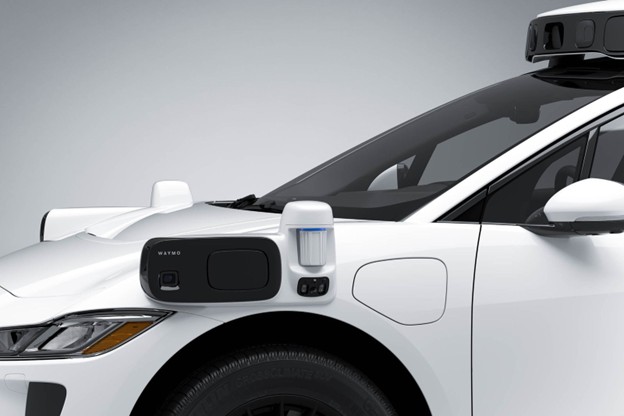
In the race to commercialize autonomy, companies like Waymo have declared their hardware stack design good enough, fixed — at least until the next generation. That fifth-generation stack—five lidars, twenty-nine cameras, six radars—looks as well integrated as so much external hardware could.
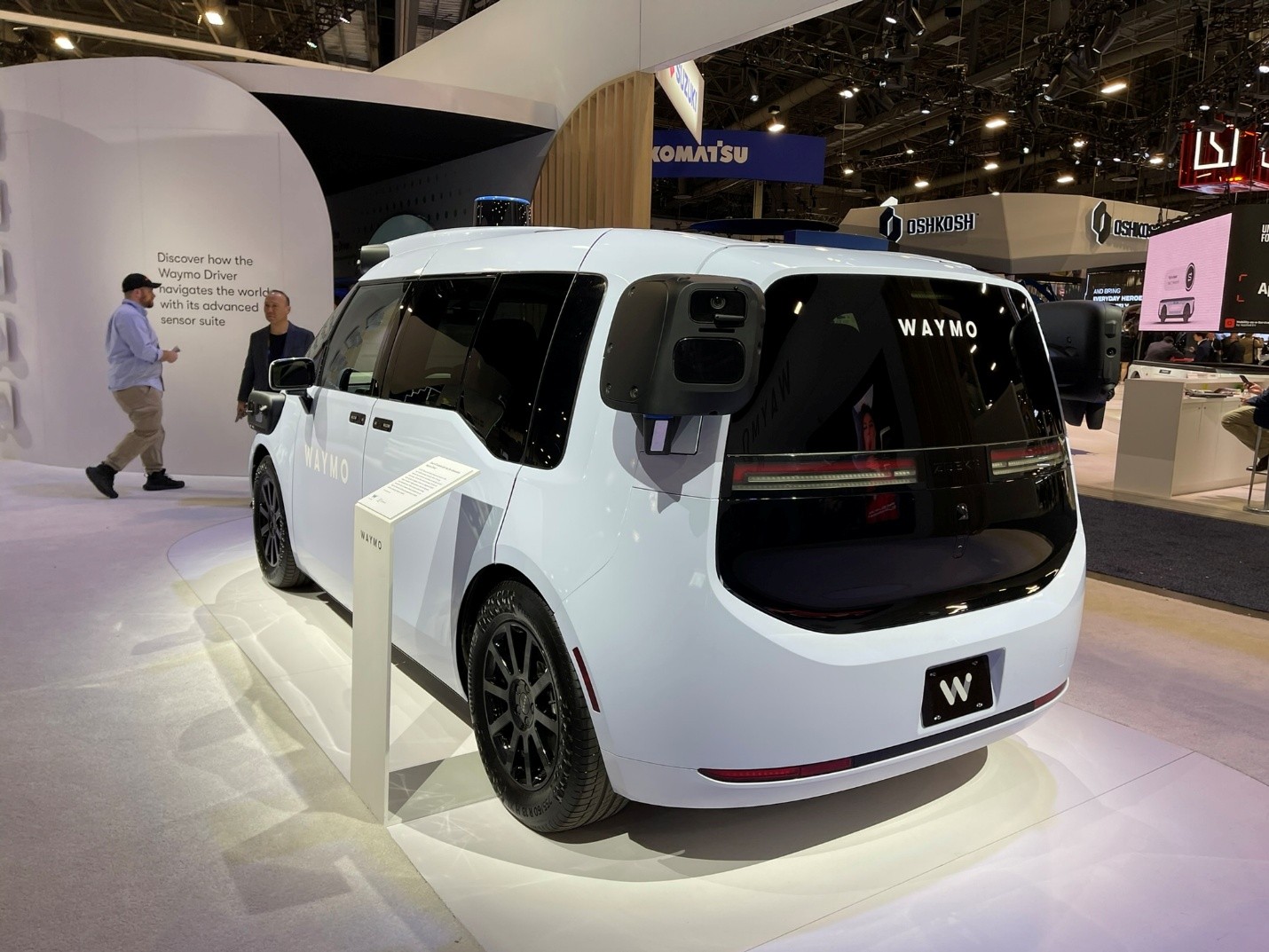
But Jaguar’s decision to discontinue the I-PACE at the end of 2024 has forced Waymo to find another base vehicle. Enter the Zeekr RT, a purpose-built robotaxi developed with Geely Group. The Zeekr will have on it Waymo’s sixth-generation autonomous system.
The Gen 6 Driver cuts the number of sensors (13 cameras, 4 lidars, 6 radars) but adds external microphones to detect sirens, horns, and shouted commands. “Smarter placement,” Waymo says, provides better near-body awareness, with low-mounted cameras and perimeter lidars hugging the curb line.
It still lacks is a sensors under the vehicle, though. Considering that Cruise dragged a woman underneath and that KitKat was run over, this is indeed a glaring omission.
Adding under-vehicle detection would not break the budget by any means. Two downward-facing automotive-grade cameras, complete with housings, wiring, and software integration, would cost perhaps $300–$700 per vehicle in large-scale production. The optics/housing/harness might add $80-$250 each, and the software/integration/validation another $100-$300. A total of $1,500 for such under-vehicle detection would be only 1% the cost of a $150,000 sensor package.
The Inevitable Next Catastrophe
Waymo’s Zeekr robotaxis will soon roll out of its new Mesa, Arizona, factory and into American streets. Each mile driven without a human at the wheel pushes AV forward—but each accident, injury or death, is a giant leap backward.
KitKat’s death has caused somewhat of an international sensation. KitKat’s death may fade from public attention. No matter how beloved was KitKat, it’s death may still be able to stall Waymo. Waymo’s course through the the streets of San Francisco now just as they did before. But, perish the thought, should a child get caught under the wheels, it most certainly would be strike three for robotaxis.
________
This article is an updated version of my article published on LinkedIn.
