

In crowded environments, adding more robots does not always lead to better performance. New research shows that beyond a certain point, congestion causes robots to interfere with one another, slowing overall progress. The key to maintaining efficiency, researchers found, lies not in stricter coordination but in introducing a measured amount of randomness into how robots move, tells Science Daily.
The study, led by researchers at Harvard, explored how simple movement rules affect large groups of robots working in confined spaces. Using simulations, each robot, or “agent,” was assigned random starting points and destinations, continuously moving from one task to the next. Their paths included a tunable level of variation, or “noise,” ranging from perfectly straight motion to highly erratic wandering.
Results revealed a clear pattern. With no randomness, robots quickly formed dense clusters, creating traffic jams that halted movement. At the other extreme, excessive randomness reduced congestion but made paths inefficient, as robots wandered too much. Between these extremes, the researchers identified an optimal balance, a “Goldilocks zone” where slight unpredictability allowed robots to avoid collisions while still moving efficiently toward their goals.
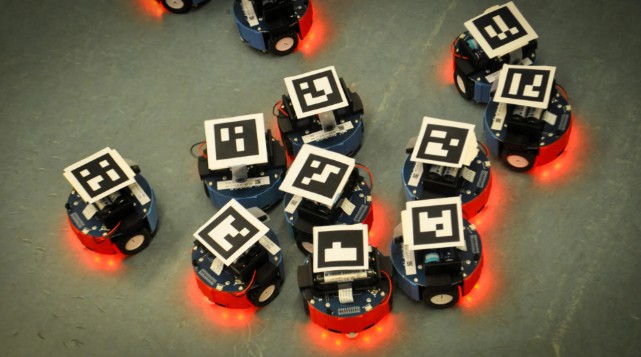
To validate the findings, the team conducted real-world experiments using small wheeled robots tracked by overhead cameras. Despite physical limitations, these robots exhibited the same behavior as simulated agents, confirming that the principle holds beyond theoretical models.
The research highlights a broader insight: complex coordination does not always require centralized control or advanced intelligence. Instead, simple local rules can produce organized, efficient behavior at scale.
Beyond robotics, the findings have implications for managing crowded systems such as traffic, pedestrian flow, and industrial operations. Introducing controlled variability into movement patterns could help reduce congestion and improve throughput, offering a new way to design systems where density and interaction are unavoidable.
