

In this Beyond PLM blog post ahead of 3DEXPERIENCE World 2026, Oleg Shilovitsky reflects on how artificial intelligence may reshape product lifecycle management (PLM) and engineering decision-making. He starts from a conversation with Marc Andreessen, who argued that the real AI boom is not defined by models or hype cycles but by where and how intelligence becomes abundant. Software made computation and coordination cheap, but the physical world, that is, engineering, manufacturing, and infrastructure, remains slow because reasoning in these domains is expensive and brittle. Shilovitsky connects that idea to PLM’s history and current limitations.
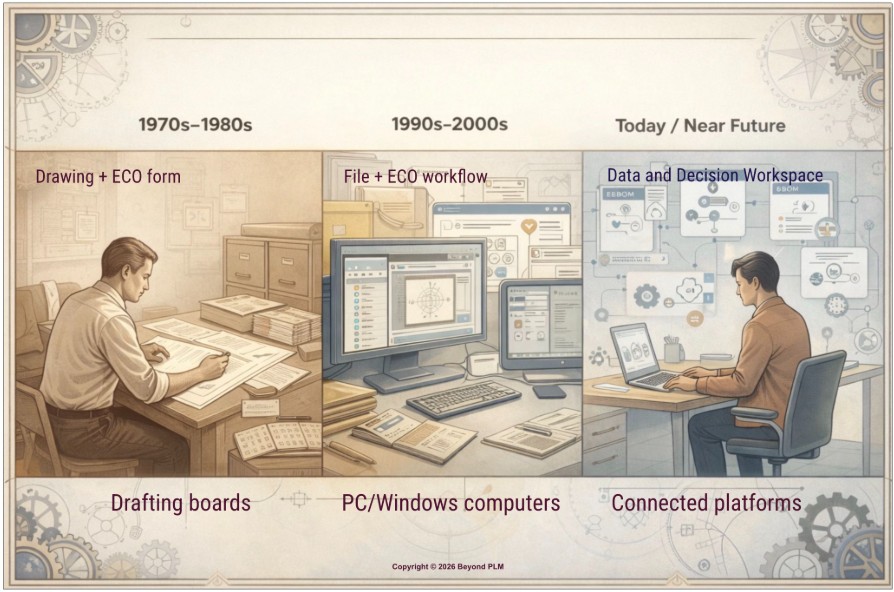
Traditional PLM and product data management emerged when computing was scarce and had two core roles: manage CAD files and enforce process control. These systems succeeded at capturing artifacts and revisions, not at preserving the context or judgment behind engineering decisions. Early decisions in product development are hard to revisit, and over time, valuable context—alternative paths considered, trade-offs evaluated, assumptions made—disappears into emails, meetings, and unstructured tools. That leaves PLM strong as a system of record but weak as a system of understanding.
Artificial intelligence changes the economics of reasoning. For the first time, machines can reason about mathematics, physics, and engineering trade-offs at scale. This shift requires PLM to evolve. Instead of storing static documents and change approvals, PLM systems may need to capture reasoning, relationships, and decision context as product memory that persists across lifecycle stages. In this view, PLM becomes a landing zone not just for data but for the continuity of reasoning.
AI in this new paradigm does not replace human judgment; it augments it by making alternatives, impacts, and trade-offs visible before decisions are locked in. The future of PLM may lie in preserving intent and context so that engineers and AI agents alike can explore options with insight rather than automating guesses.
