

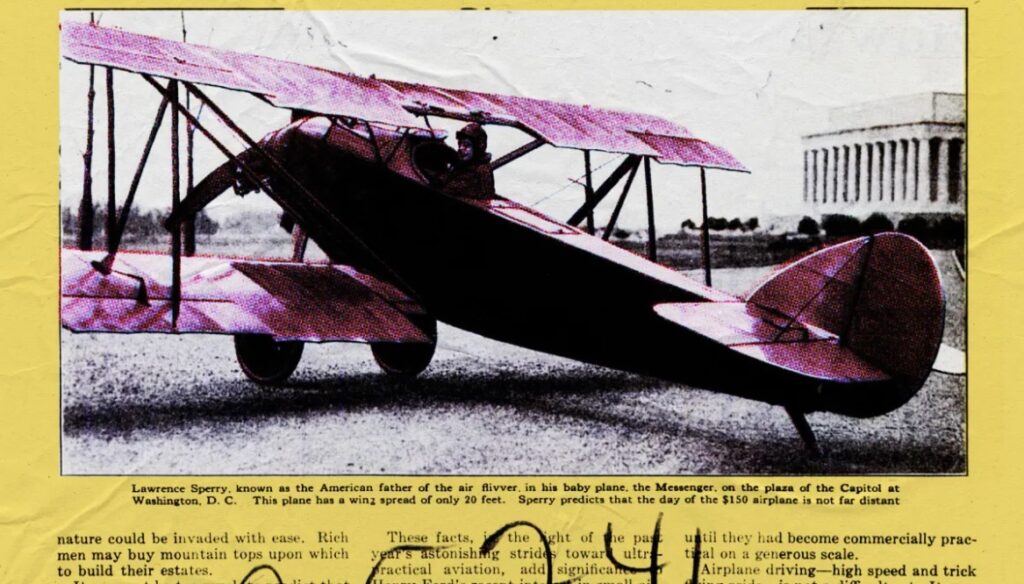
Long before modern drones and autonomous flight systems, aviation pioneer Lawrence Sperry demonstrated that airplanes could fly themselves. A Popular Science article revisits his work during World War I, showing how early autopilot technology reshaped both aviation safety and the concept of unmanned flight.
In the early 1910s, flying was physically exhausting and dangerously unstable. Sperry addressed this by developing a gyroscope-based autopilot that could automatically stabilize an aircraft. His invention allowed planes to maintain level flight without constant human input, solving one of aviation’s biggest challenges at the time.
A widely reported 1916 incident illustrates both the risks and promise of the technology. While flying with a passenger, Sperry accidentally disengaged the autopilot, causing a crash into the water. Though sensational headlines focused on the mishap, the deeper lesson was clear: the autopilot itself had been performing more reliably than the human pilot.
Sperry quickly recognized the broader implications. If an aircraft could stabilize itself, it could also be controlled remotely or follow a preset course without a pilot onboard. This insight led to early experiments with pilotless aircraft, including “aerial torpedoes” designed to carry explosives. These systems, though primitive, introduced the core idea behind modern drones.
The technology relied on mechanical systems rather than digital computation. Gyroscopes detected changes in orientation, and control mechanisms adjusted the aircraft’s surfaces to maintain stability. Despite its simplicity, this approach proved remarkably effective and became the foundation for later autopilot systems.
Although these early unmanned systems were not widely deployed during the war, Sperry’s work fundamentally changed aviation. His innovations improved flight safety and introduced the possibility of autonomous aircraft decades before they became practical.
The legacy is unmistakable. Today’s drones, guided by advanced software and sensors, trace their origins back to Sperry’s early experiments. His work turned the idea of pilotless flight from speculation into engineering reality, setting the stage for a century of innovation in autonomous aviation.
