

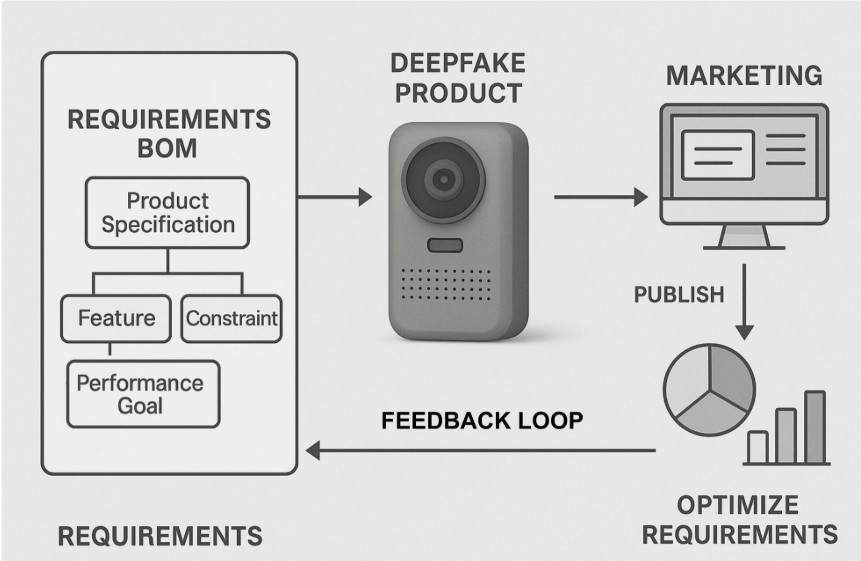
In his blog post on Beyond PLM, Oleg Shilovitsky argues that deepfake technology—often dismissed for its role in misinformation—can teach us something valuable about product development. In marketing, synthetic media are used to create content, test audience response, and feed data back into fast optimization loops. Why not apply the same idea to PLM?
The key is the Requirements Bill of Materials (BOM), a structured list of what a product should do, not how it is built. Unlike a traditional BOM of parts and geometry, the requirements BOM defines functions, features, performance targets, and constraints. By generating a “deepfake product” based on those requirements—think digital rendering, VR demo, interactive simulation, or mock-up—companies can share a convincing prototype without a physical build. That lets potential users react early.
Here’s how the feedback loop works:
- Model requirements in a requirements BOM.
- Generate synthetic product experiences from that BOM (renderings, simulations, VR, etc.).
- Expose them to users or markets through marketing channels, surveys, or demos.
- Collect data through clicks, responses, and preferences.
- Refine requirements based on real feedback.
This brings agility to PLM: instead of waiting until a solid prototype exists, teams can iterate rapidly based on actual market reactions. Shilovitsky highlights how this can reduce risk, align products more closely with customer needs, speed up iteration, and unify marketing and engineering into a data-driven workflow. Requirements become hypotheses, not just a list to follow.
Why deepfake-style products matter for PLM
- Early validation: Test product ideas before any physical prototype costs are incurred.
- Customer alignment: Capture real feedback to focus resources on features that matter.
- Faster iteration: Quickly refine requirements instead of waiting for late-stage tests.
- Cross-functional integration: Connect marketing insight directly to engineering decisions.
- Dynamic requirements: Treat requirements as living hypotheses, evolving with data, not fixed documents.
