

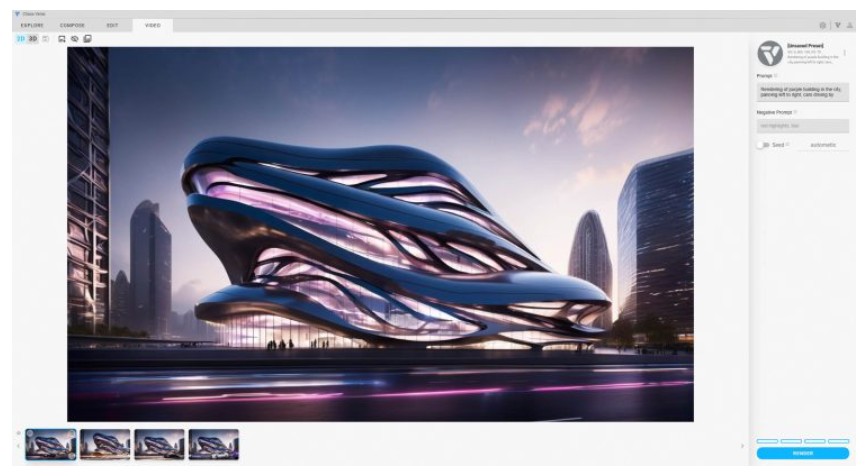
In this AEC Magazine article, author Greg Corke lays out how generative AI is reshaping architectural visualization. Traditional tools such as Enscape and V-Ray, long staples in design workflows, are evolving as Chaos weaves in AI-driven rendering capabilities.
At the heart of this shift is Veras, an AI rendering engine acquired by Chaos’s parent company, EvolveLAB. Veras can transform a 3D model snapshot, sketch, or reference image into richly styled visuals, offering dozens of aesthetic variations from the same base scene. It’s integrated tightly with BIM and CAD tools such as Revit, SketchUp, Rhino, and Archicad, giving designers control over material, lighting, and composition.
Veras 3.0 pushes further: it supports short video outputs. Designers can generate dynamic pans, zooms, animated lighting effects, or subtle motion in scenes, automatically guessing what should move (e.g., fireplaces, ambient people) based on prompts. The system uses Stable Diffusion as its core engine, with layered capabilities allowing users to choose among different model versions for geometry fidelity or style.
Chaos also pairs traditional rendering with AI-enhancement tools. For example, AI Upscaler lets users generate low-res renders quickly and then upscale them inside Enscape or V-Ray while preserving detail. And AI Enhancer can improve elements (humans, foliage, materials) by leveraging metadata from the visualization tool, so the AI “knows” what it is improving.
Moreover, Chaos is expanding into AI materials: designers can take a photo of a sample material and convert it into a full material set (albedo, bump, roughness) usable in renders. The AI Material Recommender suggests materials from its library based on prompts or reference visuals.
A provocative insight from Chaos’s product lead is this: whereas design earlier began with modeling, then rendering, increasingly it may start with rendering (i.e., image first), followed by modeling. The two workflows converge, and Chaos is exploring how AI prompts, geometry, and traditional CAD tools interplay in this future.
Chaos is taking visualization from pixel rendering toward prompt-driven storytelling. It’s not eliminating geometry, but providing designers new ways to get expressive visuals faster, and pushing the question of whether modeling will always be the first step.
