

 The internal combustion engine in my Mercedes sedan is so smooth and quiet that it cannot be heard or felt from inside the car, where the noise level is all of 70-75 dB. IC engines have become quite refined compared to the sputtering, loud monsters found in early vehicles. We have to be reminded that the power comes from fuel literally exploding in cast iron cylinders. IC engines power almost all our transportation, including aircraft — though to fly, they have to shed the cast iron. Too heavy.
But the cast iron was the last line of defense against an IC engine throwing a piston. Lacking the protection of iron and steel, a jet engine’s spinning turbine blades are prevented from flying off and piercing the cabin by shrouds of Kevlar. It works almost all the time.
But then there is the fuel itself—a massive amount of it. A Boeing 787-9 can take off with over 33,000 gallons of fuel, or 115 gallons per passenger seat. That would be like towing a mini tanker trailer — an inherently dangerous way to travel.
By comparison, an electric power system is far safer. No highly volatile fuel, no cabin-piercing turbine blades… Add a green hydrogen fuel cell, and you can extend the range and actually go places. With fewer moving parts, it costs less to maintain.

An aircraft that uses electric power and or green hydrogen would be a more sustainable way to travel, quieter and cheaper. What’s not to like?
Nothing we can’t handle, says David Doral, CEO and founder of Australian startup Dovetail Aviation. An aerospace engineer (Universidad Politécnica de Madrid, Spain), Doral has worked at Boeing, Airbus and Embraer (via Aernnova) as a structural engineer before moving to management roles.
As Doral explains on a Siemens podcast, the aviation industry currently suffers from a perception that it is anything but green, a perception Doral is working hard to correct. Jet engines burn fossil fuel and leave air pollutants and CO2 high in the atmosphere. The very act of going from one place to another via an airplane almost demands an apology.
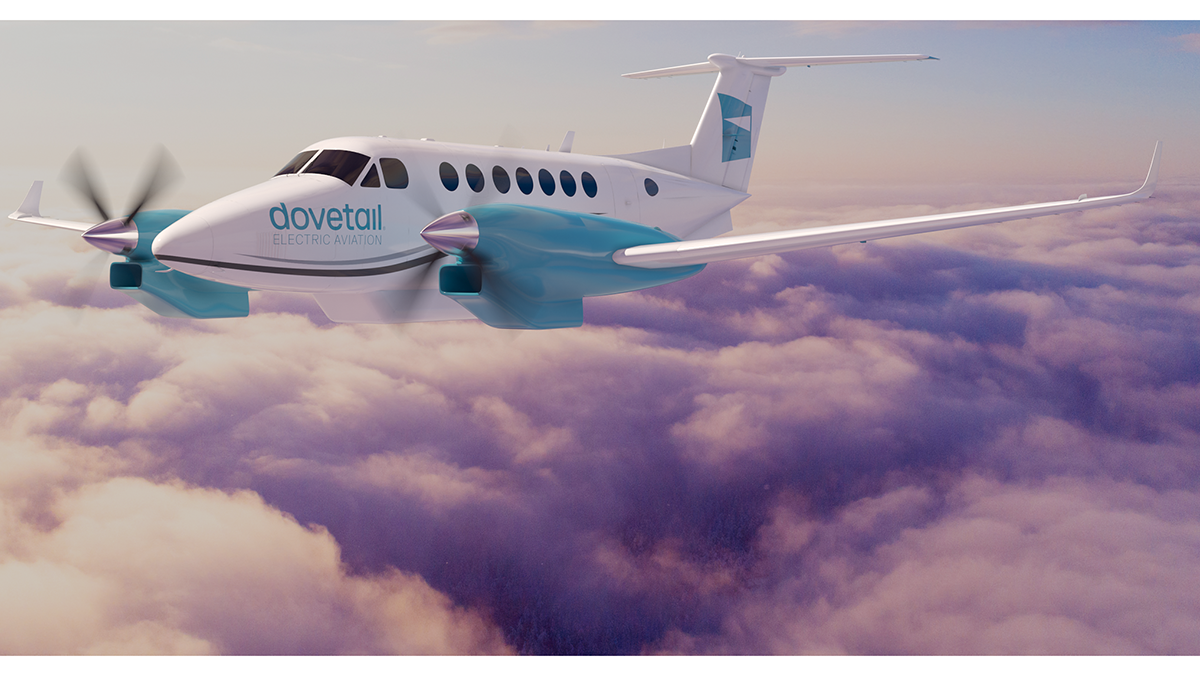
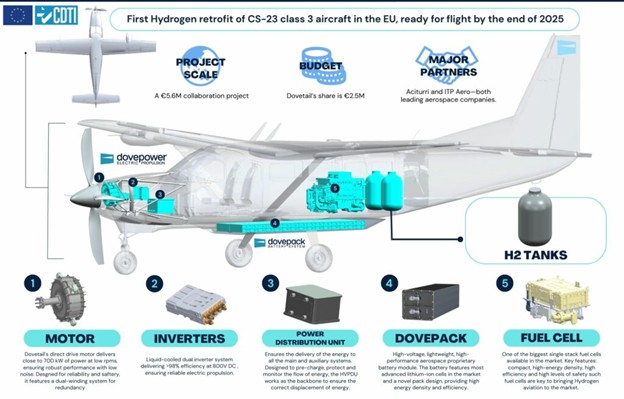
New air mobility initiatives have spawned hundreds of new aircraft designs. Dovetail has what they think is a better way. Instead of taking 10 years and hundreds of millions of dollars, perhaps billions, Dovetail plans on retrofitting existing aircraft.
Retrofitting an existing small, propeller-driven aircraft can be done in a few years, according to Doral, as most of the airworthiness certification required by aviation’s regulatory agencies is avoided.
Remaining Issues
 It may seem chilly on a flight, but it is survivable, a sharp contrast to the environment outside the cabin. At a cruising altitude of 40,000 feet, the temperature — you’ve heard the announcements — is 40 degrees below zero.[i]. And be glad you have oxygen at elevations miles above what mountain climbers call the death zone[ii] The pressure in a Boeing 777, whose fuselage is strapped with carbon fiber filaments, can be pressurized to an effective elevation of 8,000 ft. You can thank aerospace engineers who have found ways to use heat and pressure from jet engines to create what is essentially a life-support system in the sky.
Not having the heat and pressure, essentially for free, makes it more challenging to heat and pressurize the electric aircraft cabin. Those are two of the few issues to be settled when it comes to electric-powered flight, says Doral.
“You use a lot of the excess heat from the exhaust gases for these purposes, and pressurization of the cabin relies a lot on the compressed air coming from the top of the engines,” says Doral.
Those are systems that Dovetail needs to develop alternative solutions for.
“You need to set up a whole new heating and pressurization system basically,” says Doral. “It’s not a huge deal; it can be done.”
Enter Siemens
At Dovetail Electric Aviation, the centerpiece of the company’s design work is Siemens’ NX X software—part of the Siemens Xcelerator portfolio—used for everything from developing new components to integrating them into legacy aircraft.
‘We are heavy users of Siemens NX X. That’s our main CAD package, and that’s what we’re using to generate new models, to develop new components and new systems. Doral explained that the company’s engineers in Australia and Spain work in parallel on the same designs, with NX enabling real-time updates across continents.
“It’s a very powerful collaborative tool,” says Doral of NX X. “We are an Australian company, but we have a Spanish subsidiary. We have people basically working literally a world apart. The kind of out-of-the-box integration that NX provides is of significant value. It is enabling us to design something in Australia here, and the team is working on that in real time and delivering a result overnight.
NX also plays a role in linking design and analysis, especially when integrating new technology into decades-old airframes. Dovetail’s retrofits often require creating a “digital baseline” from scratch by scanning existing aircraft. NX X integrates these 3D scans with the company’s proprietary designs, allowing engineers to match new systems—such as electric propulsion components—to the old structures with high precision.
“The 3D scans that I mentioned from existing airframe structures can also be integrated. We may be modifying all aircraft, but with a lot of new technology and digital tools for guidance. The digital tools allow us to accelerate this process.”
Also, the integration with analysis packages is critical.
Another deciding factor in choosing NX X, Doral said, was its ability to handle large assemblies without bogging down, a critical requirement when dealing with complete aircraft models. The software’s built-in product lifecycle management (PLM) capabilities were equally important. “We needed an out-of-the-box PLM system that would help us handle, manage, deal with models and deal with traceability—basically all the features required to release new products,” Doral noted.
Traceability is not just about internal order; it’s essential for certification. Regulatory authorities demand exhaustive documentation on every change, test and revision. “Having a robust digital database that can help us structure our whole product and show very clearly how all those different components have been designed, all the revisions… is critical,” Doral said. “We’re bringing a product to market that people will be using for flying, and we need to meet the highest standards of safety. For that, you need the right tools.”
Doral emphasized that Siemens’ technology helped bridge the gap between a startup’s agility and the aerospace industry’s stringent requirements. In his words, NX offered “the right combination of powerful tools, capability to work with large assemblies, and affordability”—and, perhaps most importantly, a growth path that could scale as Dovetail moves from retrofitting its first aircraft to launching larger, more ambitious programs.
The Future of Aviation Could be Quieter, Safer, Cheaper
Assisting Dovetail in its remaining challenges is Siemens’ digital twins. Simulations of aircraft propulsion systems are helping extend the range of the electrically retrofitted aircraft.
And electric aircraft, created with today’s technology, such as battery technology, make perfect sense for a 100-200 mile flight. For larger aircraft and longer flights, hydrogen must come into play, either with a hybrid system (battery/hydrogen) or pure hydrogen.
Dovetail’s commitment to green energy, like its commitment to Siemens NX, is solid. The former drives his mission to decarbonize short-haul aviation; the latter gives him the means to turn that vision into hardware. In Dovetail’s hangars, NX is more than a design platform—it’s the connection linking engineers in Sydney and Seville, integrating decades-old fuselages with quiet, safe electric propulsion systems, as well as providing documentation for every modification to satisfy regulators.
If the company’s early retrofits deliver on their promises—quieter flights, lower operating costs, and zero emissions—Dovetail could offer a rare aviation story in which the economics work as well as the environmental math. That combination, rare in the green-energy sector, might prove just as disruptive to regional air travel as the software behind it. As Doral sees it, the flight path to a cleaner sky isn’t just plotted on aviation charts; it’s also rendered in digital assemblies, down to the last bolt.
This article is based upon an episode called The Future of Hydrogen-Electric Propulsion with Siemens and Dovetail from the Siemens Talking Aviation Today podcast series hosted by Todd Tuthill, Vice President of Aerospace, Defense, and Marine and Patty Russo, Global Marketing Senior Manager, both from Siemens Digital Industries Software.
[i] Degree Fahrenheit or Centigrade, it’s the same.
[ii] Mountaineers call regions above 8,000 meters (26,247 feet) “death zones” because staying there too long without oxygen can cause brain cell damage, impaired judgment, and eventually death. Strangely, climbers can still feel alert even though their cognitive abilities are deteriorating.
