

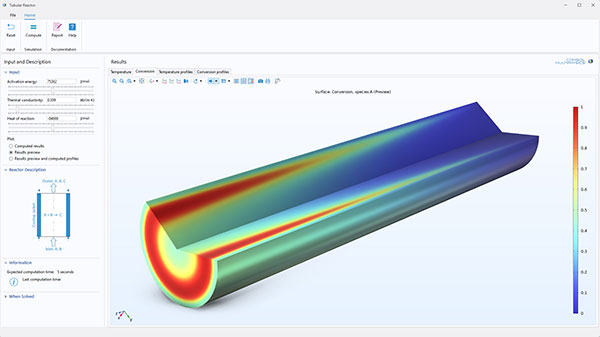
Reduced-order models (ROMs) are catching on in engineering because they speed up simulations dramatically. But in this recent Digital Engineering article, experts argue that ROMs, however useful, cannot fully replace full multiphysics finite element analysis (FEA) when dealing with complex engineering problems. The more nonlinear a system is, the harder it becomes for a ROM to keep up.
One core limitation is that ROMs are heavily dependent on training data. They work well when a system behaves similarly to examples in that data, but if operating conditions change, or if unexpected physics kick in, the ROM may produce unreliable results. This is especially true for systems with strongly coupled physical phenomena (thermal, mechanical, fluid, etc.), where small errors or missing interactions can lead to large deviations in the outcome.
Another issue is interpretability and understanding. Full multiphysics FEA gives engineers visibility: where stresses concentrate, how different physics interact, and how boundary conditions affect behavior. ROMs often act like “black boxes,” giving faster answers but leaving out insight into what’s happening under the hood. That matters a lot for safety-critical designs, validation, and when you must diagnose failures.
ROMs also struggle with robustness when faced with geometric complexity, large deformations, or highly nonlinear materials. When problems stray far from the realm of what the ROM was trained on, accuracy drops. In such cases, full FEA still remains the gold standard.
The conclusion isn’t that ROMs are useless; they have strong roles in early design, real-time monitoring, optimization loops, or digital twins where speed is crucial. But for simulations where high fidelity, safety, or understanding is required, ROMs can’t yet replace comprehensive multiphysics FEA. The two tools are complementary. ROMs accelerate; FEA explains and validates.
