

First It Came for the Developers
(A poem for jobs disappearing in the Age of AI)
First it came for the developers,
and I did not speak out—
because I don’t write code.
Then it came for the customer service reps,
and I did not speak out—
because I don’t deal with customers.
Then it came for the artists,
and I did not speak out—
because I am no artist.
Then it came for the writers,
and I did not speak out—
because I am an editor.
Then it came for me,
and there was no one left
To speak out for me
German pastor Martin Niemöller’s wrote First it Came, a heart-rending poem about how Nazis dealt with people they had no use for. The adaptation above was written after reading one report after another about how AI has taken over many jobs and made humans useless. Not all humans, mind you, just those who use their minds instead of their hands.
Goodbye Golden Ticket
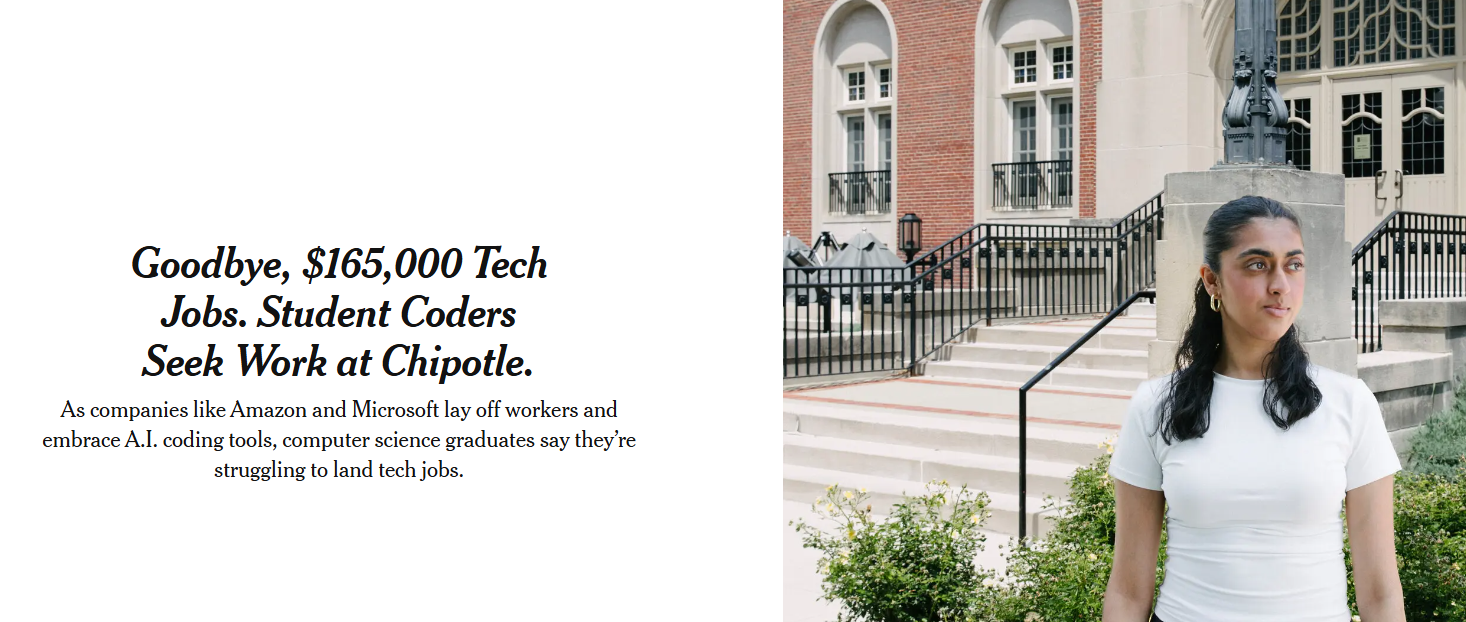
Today’s New York Times has a story on Manasi Mishra, a computer science graduate who can’t get a programming job and is applying for a job at Chipotle. In her TikTok, she gets ready for her interview. She didn’t get the job. But her 147,000 views may signal a career change as an influencer. The article reveals the dire straits in which computer science graduates now find themselves. Only a couple of years ago, a degree in computer science was the golden ticket, and graduates had to bat away offers of over $100,000 with signing bonuses. This year, they are applying for thousands of positions and getting zero responses.
The Wall Street Journal had already weighed in on the subject with AI Is Wrecking an Already Fragile Job Market for College Graduates.
We are in a job market turned upside down, with biology and art history majors having half the unemployment of computer science and computer engineering majors.
Part of the problem may be oversupply. There were 170,000 computer science graduates in 2024 compared to less than half that number 10 years ago, according to the Times article. The other part of the problem is AI. New grads are entering a job market decimated by AI.
At the forefront of the jobs lost to AI are tech companies. Earlier this year, executives at Shopify and Fiverr told managers to see if AI could do the job before hiring for any position.
AI is indeed shaking the world of all white collar workers. We might concede to AI jobs that can be learned quickly, such as data entry, credit checking, form filling, legal and patent research… But AI is advancing faster than an out-of-control forest fire. It has consumed customer support, even for technical products, clerical and research positions.
But Engineers are Indispensable, Right?
How long can professionals console themselves with thoughts of how indispensable they are to society, how valuable their insight is, and how unique their ability to harness math and science is that lets them advance technology and solve the world’s problems? Okay, we concede it can pass a test on engineering theory (like the FE exam, more on that later), but engineering in the real world?
AI may have made a mess for computer science graduates, but how does it stack up against a truly gifted veteran coder?
Umm… AI does pretty well with advanced coding, actually. When Google issued a Code Red after ChatGPT’s initial success, Google engineers decided to compare ChatGPT’s prowess at writing code against their own. In an internal communication uncovered by CNBC, Google engineers were surprised to find ChatGPT was able to pass the type of programming tests given to applicants for Level 3 software engineer positions that paid over $180,000. That was in 2023.
But How About Real Engineering?
Do the job losses among software engineers have “traditional” engineers looking over their shoulders?
Engineers have some time before AI catches up to them. Unlike computer languages, which have a limited vocabulary, hundreds of words max and well-defined rules, which make them ideal for mastery by large language models (LLMs), the language and understanding of engineering is considerably more nuanced and less quantifiable. Also, all the publicly available code lies in abundance, thanks to coding platforms like GitHub, providing a veritable feast for LLMs to train on. On the other hand, data for training AIs in non-language modalities, like shapes and physical behavior (stress analysis and fluid flow), is sparse, confined to what a company has in its vaults.
Can You Hear It Knocking?
While ChatGPT cannot yet get hired as an entry-level engineer, it still knocks on the door. With their remarkable ability to read and remember everything, it was just a matter of time before someone tried to give one the PE (professional engineer) test.
Enter Cornell University, which fed PE test questions to ChatGPT 4 and published the results in March of 2023.
To get a PE license, engineers must first take the Fundamentals of Engineering (FE) exam, which tests “book-learning,” or basic math, science and engineering theory. ChatGPT got a passing score of 70.9% on the FE. It didn’t do so well in the 2nd part of the PE exam, however, where applicants are given “real-world” problems, failing with a score of 46.9%.
But that was dog-years ago, though. The researchers projected that “future editions [of ChatGPT] are much more likely to pass both exams.”
Last week, OpenAI released ChatGPT 5.
The Rise of the Agents
The talk of AI now is not about replacing engineers but assisting them. Jensen Huang, CEO of NVIDIA, and Mark Zuckerberg, CEO of Facebook, both envision a future where every engineer will have an AI agent to assist them. In theory, an AI agent would be able to free the engineer for more creative purposes. In reality, it could reduce the number of engineering jobs.
While Zuckerberg was only considering software engineers and trimming the ranks of tech companies, Huang’s forecast of “everybody will have an AI assistant” is all-encompassing and, therefore, includes engineers.
Tech companies have jumped on the AI agent bandwagon, giving full-throated support for AI agents. Microsoft has stated that we will all have a small army of AI agents, all making us many times more productive.
Sounds good, right? Who wouldn’t want to be freed from drudge work? I am reminded of an engineering position I held while still in engineering school that entailed making drawings on paper. I was bored out of my mind. Wouldn’t every engineer appreciate the force multiplier effect of AI agents working under their command?
But consider your team of engineers. What if all of you were given AI agents? What if all of you were 10 times more productive? What is your company going to do with all that productivity?
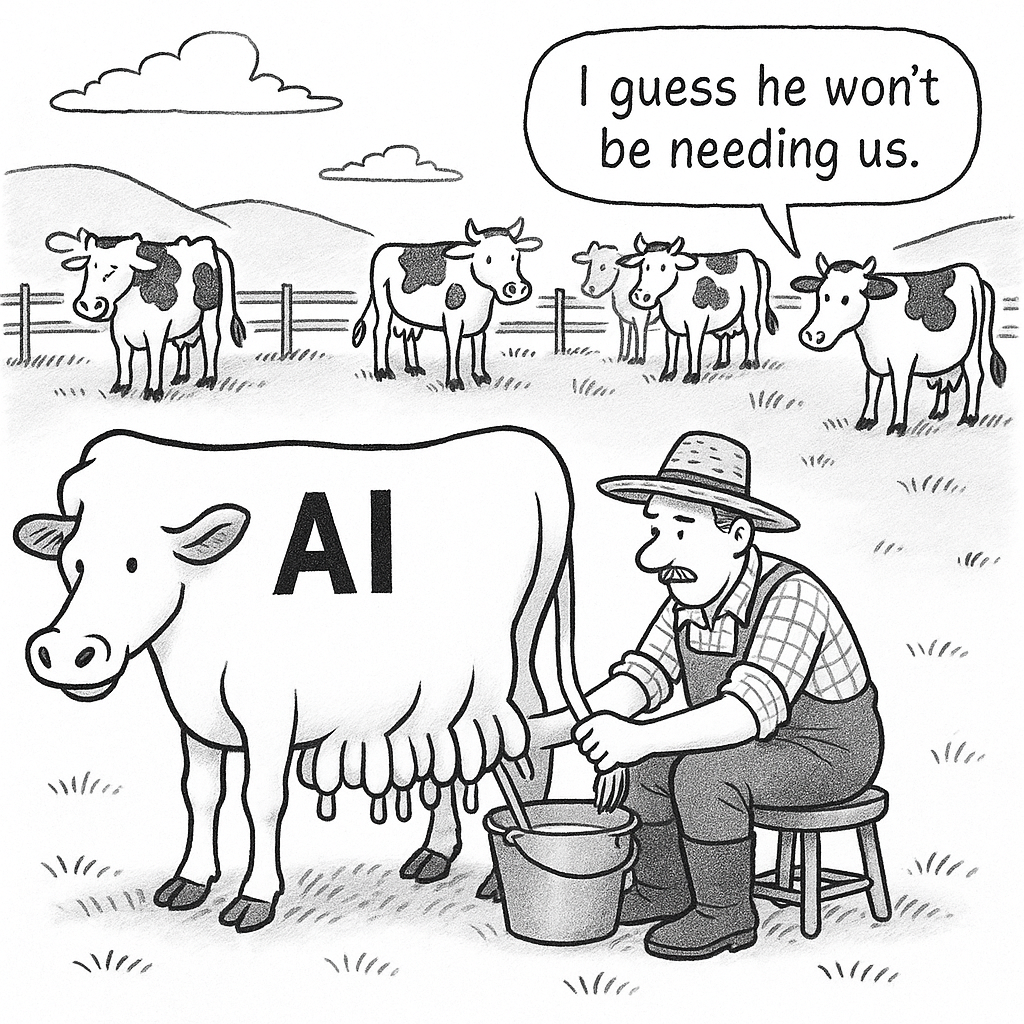 Should each cow in a herd sprout nine more udders and make 10 times as much milk, will the farmer be able to sell all that milk? It would bring the price down. More likely, the farmer would reduce the herd to a tenth of its size and benefit from less care, maintenance and infrastructure of a smaller herd.
And in that way, AI will have reduced the number of jobs for engineers. With each engineer doing the work of many, there is a smaller total number of engineers.
Heard This Before
Whether AI agents will prove to be helpful and to what extent they can scale an engineer’s productivity remains to be seen. The engineering profession has weathered dire forecasts before.
CAD came on the scene in the 1980s with claims of 10X productivity, and designers and engineers faced similar fears of their jobs vanishing. It didn’t happen. In a 2007 study, German researchers claimed that as much as 50% of an engineer’s time is spent searching for information. The claim became the battle cry for online service information vendors, like Thomas Register (publishers of TOMCATs), and GlobalSpec. Similarly, engineers may have seen extinction looming before them. Again, it didn’t happen.
Engineering remains as necessary now as it has ever been—perhaps more so. The problems we face are multiplying: climate change, infrastructure decay, global competition and resource scarcity. The number of people on the planet is on a hockey stick curve. More than at any point in history, the world needs the ingenuity and problem-solving capability of engineers to keep people safe and secure, not just survive but thrive. AI will not change that fundamental need.
What AI will change is how we work. It will insert itself into the workflows of every discipline, just as CAD, simulation software, and the Internet did before it. It will become a constant presence—sometimes in the background, sometimes front and center—shaping decisions, filtering information and handling the repetitive and mechanical parts of engineering. Like every tool before it, AI has the potential to amplify human capability, but it can also concentrate power.
The danger to the engineer is not that AI exists—it’s that others will use it better, faster, more often than you do. Neglect it, and you will find your value diminished relative to them, your relevance to the modern world questioned. Embrace it, and you make yourself indispensable, not disposable. Learn how to prompt it, train it, and direct it with the same precision you bring to solving a structural analysis problem or debugging a control system.
History has shown that new technology rarely removes engineering jobs—but more often it reshapes them. Those who thrived were the ones who adapted to new technology early. AI will be no different. Treat it as an extension of your own capability, not as an adversary. Let it do the drudgery while you take the lead and be creative. And above all, press for more—more access, more capability, more opportunity to use it in ways only an engineer can imagine.
