

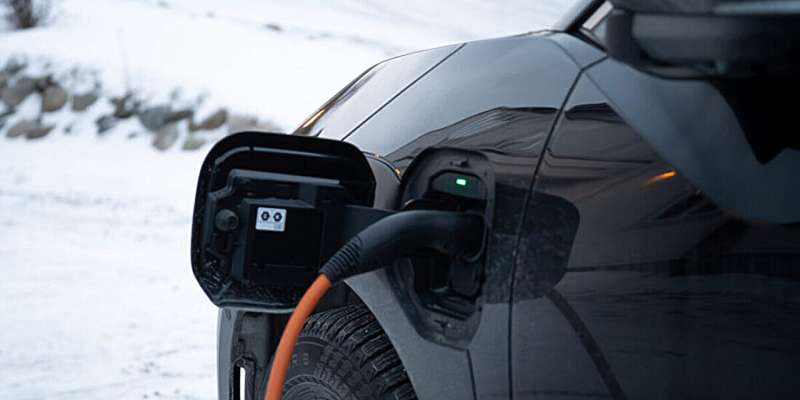
Cold weather significantly affects the performance of electric vehicle batteries, often reducing driving range and slowing charging speeds. According to battery expert Mari Vullum-Bruer, low temperatures interfere with the chemical processes inside lithium-ion batteries, causing them to operate less efficiently and making electric cars require more frequent charging during winter, tells Tech Xplore.
The main reason for winter range loss is not the use of cabin heating, as many drivers assume, but the impact of cold temperatures on the battery itself. When the battery becomes cold, the electrochemical reactions that allow lithium ions to move between the electrodes slow down. As a result, the battery delivers less usable energy, and the vehicle’s range can drop significantly. In extremely cold conditions around −20°C, electric vehicles may lose 20–50% of their typical range.
Heating the cabin does consume electricity, but it represents a relatively small portion of overall energy use. Preheating a vehicle typically requires about 0.5–1.5 kilowatt-hours of energy, while maintaining interior warmth during driving may consume around 1–2 kilowatt-hours per hour. In comparison, the cold-induced inefficiency of the battery itself accounts for most of the winter performance loss.
Cold temperatures also affect charging behavior. Lithium ions move more slowly at low temperatures, meaning that fast charging becomes less efficient and can even damage the battery under certain conditions. Charging an extremely cold battery may cause lithium plating, a phenomenon in which metallic lithium forms on the anode surface instead of being stored safely inside the battery material. Over time, this process can degrade performance and may even create dendrites that risk short circuits.
Experts, therefore, recommend several practical strategies. Drivers should preheat their vehicles while they are still plugged in, charge the battery soon after driving when it is warm, and avoid repeatedly charging to 100%. Maintaining the battery between roughly 20% and 80% charge can help extend its lifespan.
Although research into next-generation technologies such as solid-state batteries continues, current lithium-ion systems still dominate the market. Until new designs reach mass production, winter driving will remain a challenge that electric vehicle owners must manage carefully.
