

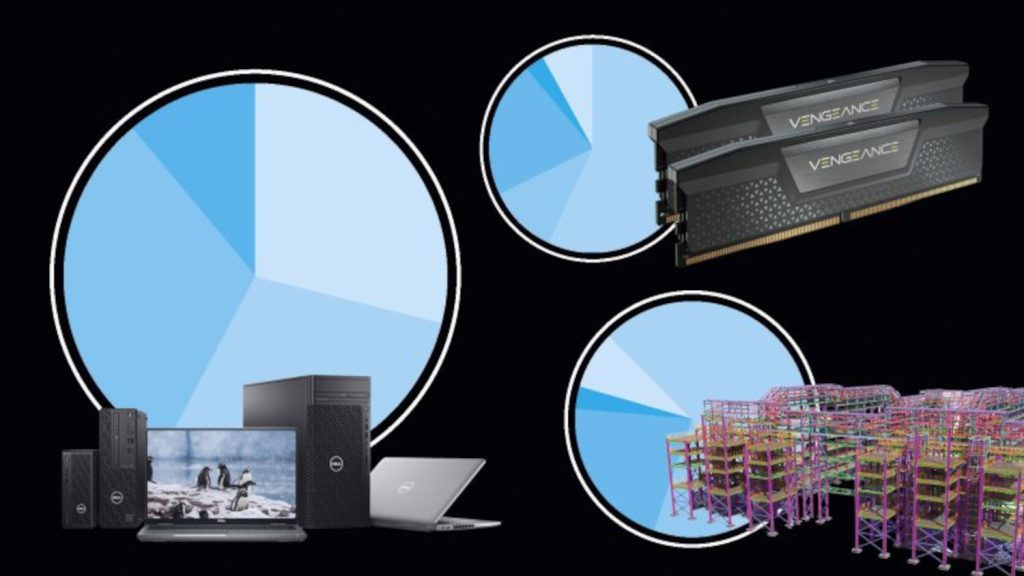
Develop3D’s 2026 workstation survey captures how design and engineering professionals are equipping themselves for demanding CAD, visualization, simulation, and mixed workloads. Based on responses from more than 200 practitioners, the data paints a picture of practical, performance-oriented setups rather than experimental or marginal configurations. The results reveal common hardware choices, usage patterns, and bottlenecks that reflect real-world priorities within the workstation community.
Desktop towers remain the standard workstation form factor, prized for performance headroom and expandability. More than a third of respondents also use mobile workstations, underlining the persistence of hybrid and flexible work, while small form factor machines exist primarily as space-efficient alternatives rather than performance leaders. Cloud and remote-based workstations remain a minor slice of the market, suggesting they are not yet mainstream for heavy design workloads.
On the graphics front, Nvidia RTX GPUs dominate professional setups, benefiting from broad OEM availability and strong support for visual computing tasks. Consumer-oriented GeForce cards also appear frequently in specialist machines where price/performance makes sense, while integrated graphics from Intel and AMD hold small pockets of usage mostly tied to budget or secondary systems.
Processor choices reflect a balance between single-thread speed and multi-core throughput. Intel Core CPUs lead overall, particularly because high clock frequencies are critical for CAD performance, with Intel Xeon chips still present in enterprise-focused workstations. AMD’s Ryzen line holds a solid share, and high-end Threadripper (Pro) systems serve niche users with extreme compute and memory needs.
Memory and display choices also show clear trends. Most workstations feature 64 GB of RAM, with a sizable minority at 128 GB or more to support complex datasets and parallel workflows. Dual-monitor setups dominate, supporting multitasking workflows that blend modeling, reference tools, and visualization, while higher-resolution panels are increasingly common.
Performance bottlenecks center on fundamentals: slow model loading tied to single-thread CPU performance tops the list, followed by viewport lag and long render times that are classic pain points in CAD and visualization workflows.
Overall, the survey underscores that workstation choices among professionals are driven by pragmatic needs rather than novelty, with emphasis on memory capacity, balanced CPU/GPU pairing, and stable multitasking environments that support the complex software stacks of modern design practice.
